You check your courier dashboard and see it: “NDR – Customer Not Available.” One update. No context. No next steps. Your shipment is stuck – and if you do not act within 24 hours, it is heading back to your warehouse as an RTO, costing you double the shipping fee and zero revenue. NDR is one of the most common – and most misunderstood – events in Indian eCommerce logistics. Most sellers know NDR is bad. Few know exactly why it happens, what the reason codes mean, and – most critically – what to do in the first 24 hours to save the order. This guide covers everything: NDR full form and meaning, how it differs from RTO, every major NDR reason code explained, a 7-step management SOP, and how to set up a system that catches NDRs automatically before they turn into expensive returns.
NDR (Non-Delivery Report) = a courier’s notification that a delivery attempt failed + the reason why. It is your early warning before a shipment becomes an RTO. Act within 24–48 hours – or pay double shipping for nothing.
- NDR Full Form and Meaning
- NDR vs RTO – What Is the Difference?
- How NDR Works in Indian Courier Systems
- NDR Reason Codes – Every Code Explained
- NDR by Courier – How Delhivery, Blue Dart, DTDC & Others Handle It
- The Real Cost of Unmanaged NDRs
- 7-Step NDR Management SOP for Indian eCommerce Brands
- NDR Prevention – Fixing the Problem Before Dispatch
- How ShipSagar Automates NDR Management
- Frequently Asked Questions
NDR Full Form and Meaning
NDR stands for Non-Delivery Report – sometimes also called Non-Delivery Receipt or Non-Delivery Notification depending on the courier. The acronym is industry shorthand across all major Indian logistics companies – Delhivery, Blue Dart, DTDC, XpressBees, Ecom Express, Ekart, India Post – though each uses it slightly differently in their tracking systems. In plain terms: an NDR is the record created by a courier company every time a delivery attempt fails – the parcel was out for delivery, the courier executive attempted to hand it over, and for some reason the delivery did not happen. That failed attempt is logged as an NDR with:
- A timestamp: Exactly when the delivery was attempted
- A location record: GPS coordinates or area of the attempt
- A reason code: The specific cause of the failure – ‘Customer Not Available’, ‘Wrong Address’, ‘Refused Delivery’, etc.
- An attempt count: Whether this is the 1st, 2nd, or 3rd attempt
The NDR is then pushed to the seller’s dashboard or tracking platform – giving them visibility into what happened and a window to take corrective action before the courier initiates RTO (Return to Origin).
| Why NDR Matters More Than Most Sellers Realize: NDR is not just a status update – it is a revenue protection opportunity. Every NDR that goes unaddressed for 24–48 hours is an order sliding toward RTO. In India, where last-mile delivery failure accounts for 53% of total logistics costs, unmanaged NDRs are one of the largest preventable drains on eCommerce unit economics. |
NDR vs RTO – What Is the Difference?
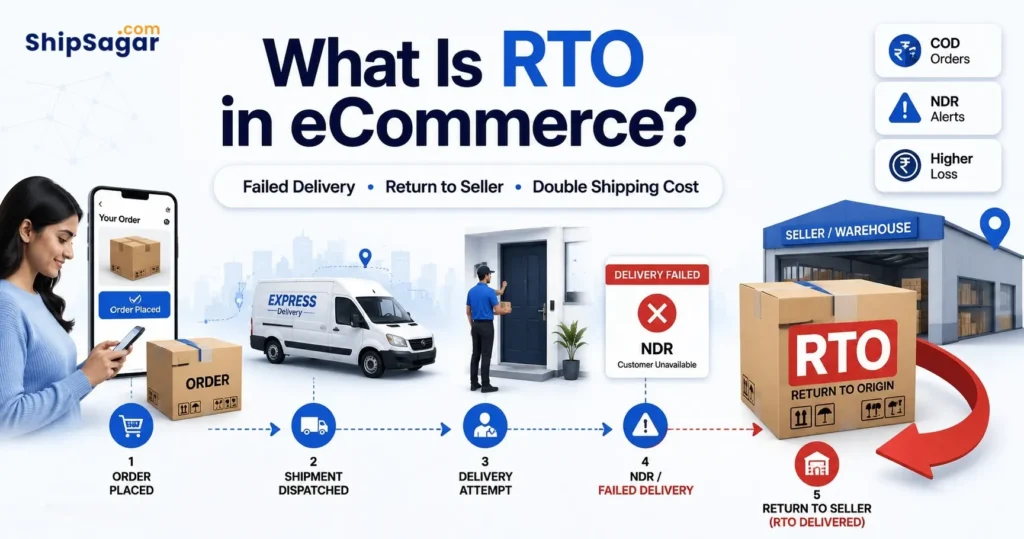
NDR and RTO are related but fundamentally different events. Understanding this distinction is what separates sellers who manage failed deliveries proactively from those who discover RTOs only when the parcel arrives back at their warehouse.
| NDR (Non-Delivery Report) | RTO (Return to Origin) | |
| What it is | Early warning – delivery attempt failed | Final outcome – parcel returning to seller |
| Parcel status | Still with courier. Eligible for re-attempt. | Return journey initiated. Cannot be stopped. |
| Timing | Fires after EACH failed delivery attempt | Fires after ALL attempts exhausted |
| Can it be saved? | ✅ YES – if acted on within 24–48 hours | ❌ Usually NO – return in progress |
| Cost at this point | Forward shipping paid. No reverse yet. | Forward + reverse shipping. Double cost. |
| Revenue | Order still recoverable – full revenue possible | Zero revenue. COD unrecovered. |
| Action required | Contact buyer, update address, reschedule | Accept return, inspect product, restock |
| The Key Relationship: Every RTO starts as an NDR – but not every NDR has to become an RTO. The gap between NDR and RTO is where NDR management earns its value. A seller who responds to every NDR within 2–4 hours can typically recover 40–60% of orders that would otherwise have returned. At scale, this recovery rate directly determines your profitability. |
→ For a complete guide on RTO – costs, causes, and prevention strategies: What Is RTO in eCommerce?
How NDR Works in Indian Courier Systems – Step by Step
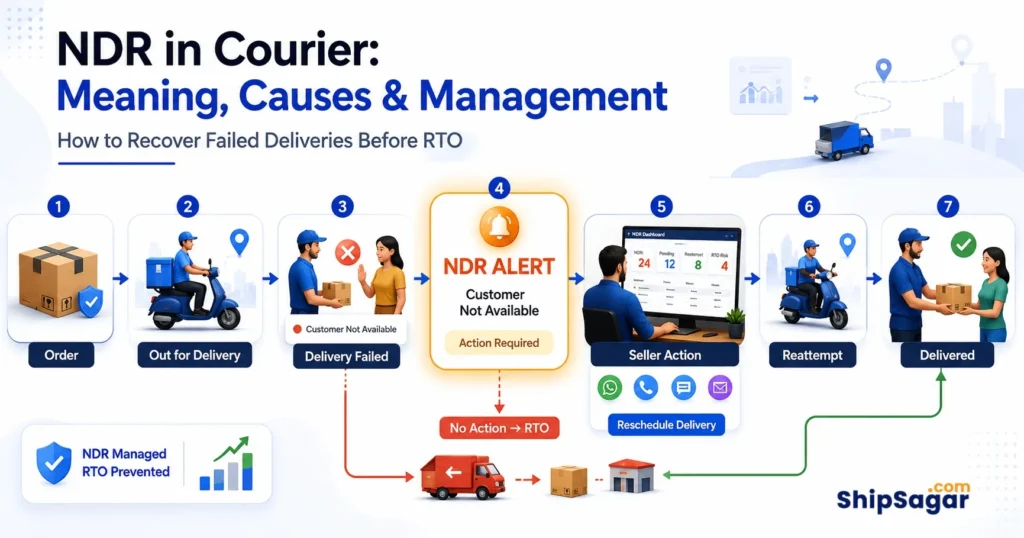
Here is the complete NDR lifecycle in Indian eCommerce logistics – from dispatch to resolution or RTO:
- Parcel dispatched and marked Out for Delivery (OFD): Courier executive picks up the parcel from the local delivery hub and loads it for delivery. Tracking status updates to ‘Out for Delivery.’
- Delivery attempted: Courier executive reaches the delivery address. Attempts to hand over the parcel.
- Delivery fails: Something prevents successful delivery – buyer is unavailable, address is wrong, COD refused, gate access denied, etc.
- NDR raised by courier executive: The executive logs the failed attempt in the courier’s mobile app – selecting the appropriate reason code. This creates the NDR record with timestamp, attempt count, and reason.
- NDR pushed to seller dashboard: Within minutes to hours (depending on the courier’s system), the NDR status appears in the seller’s courier dashboard, OMS, or tracking platform – like ShipSagar.
- 24–48 hour intervention window opens: This is the critical window. Most Indian couriers allow sellers 24–48 hours to respond – provide updated address, confirm reattempt, or request recall – before the courier schedules the next attempt or initiates RTO.
- Re-attempt or RTO decision: If the seller acts within the window and provides a resolution: courier reattempts. If no response or repeated failure: after 2–3 total attempts, courier initiates ‘RTO Initiated.’
| ⏰ The 24–48 Hour Rule: Industry data shows customers wait up to 36 hours after a failed delivery before losing interest in the order. Sellers who act on NDRs within 2–4 hours of the alert – by contacting the buyer via WhatsApp – recover significantly more orders than those who check NDRs at end-of-day. Every hour of delay after an NDR is raised increases RTO probability. |
NDR Reason Codes – Every Code Explained
NDR reason codes are the specific labels couriers attach to each failed delivery attempt. Understanding what each code means – and what action it requires – is the foundation of effective NDR management. Here is a complete reference guide to all major NDR reason codes used by Indian couriers:
| NDR Reason Code | What It Means | % of NDRs | Recommended Action |
| Customer Not Available | Buyer was not home when courier arrived. Most common NDR in India. | 25–30% | WhatsApp buyer immediately. Share reattempt window. Get availability confirmation. |
| Customer Refused Delivery | Buyer declined to accept at doorstep – changed mind, COD refusal, or mismatch with order expectations. | 15–20% | Call buyer within 1 hour. Understand reason. Offer UPI switch for COD refusal. |
| Wrong / Incomplete Address | Address has errors – wrong pincode, missing apartment, no landmark, unclear directions. | 20–25% | Get correct address from buyer. Update via courier NDR portal within the window. |
| Phone Unreachable / Not Picking | Courier tried calling – number switched off, not answered, or wrong number. Accounts for ~12% of NDRs per industry data. | 10–15% | Try WhatsApp, then alternate number if available, then email. Update correct number with courier. |
| COD Amount Not Ready | Buyer did not have exact cash. Courier cannot provide change. Common for COD orders > ₹500. | 5–8% | Offer UPI switch – send payment link. Or reschedule for when buyer has cash. |
| Customer Rescheduled Delivery | Buyer requested a specific date/time for delivery. Not a failure – a delay. | 8–10% | Confirm new delivery date with courier. Send reminder WhatsApp to buyer 1 day before. |
| Address Not Found | Courier executive could not locate the address – landmark not found, building not identifiable. | 5–8% | Get Google Maps pin from buyer. Update with detailed landmark. Add building name. |
| Office / Premises Closed | Delivery to business address – office was closed at time of attempt. | 3–5% | Coordinate delivery during business hours. Provide contact person name. |
| Gated Community / Access Denied | Security or gate policy prevented courier executive from reaching the door. | 2–4% | Provide security contact or gate pass. Ask buyer to meet courier at gate. |
| ODA (Out of Delivery Area) | Pincode falls outside the courier’s standard delivery zone. Approximately 2% of NDRs. | ~2% | Switch to courier with ODA coverage (India Post). Inform buyer of delay. |
| Fake / Unverified Delivery Attempt | Courier marked ‘attempted’ without actually visiting. Industry-acknowledged malpractice – more common in certain couriers and zones. | 3–7% | Verify with buyer if attempt was made. Escalate to courier with GPS mismatch evidence. |
Note: Percentages are estimates based on industry data from ClickPost, ShipPrime, and iThink Logistics 2025–2026 reports. Actual distribution varies by category, courier, and geography.
NDR by Courier – How Major Indian Couriers Handle Non-Delivery Reports
Each Indian courier handles NDRs slightly differently – in terms of how many reattempts they make, how quickly they push NDR updates, and what options sellers have to intervene:
| Courier | Max Attempts | NDR Update Speed | Seller Intervention Options | Notes |
| Delhivery | 3 attempts | Fast – API-based | Address update, reattempt request, buyer contact via Delhivery portal | Best NDR management portal among Indian couriers. Real-time updates. |
| Blue Dart | 3 attempts | Very Fast | Address correction, alternate delivery point, customer callback request | Premium courier – NDR rates typically lower due to professional delivery staff. |
| DTDC | 2–3 attempts | Moderate | NDR reason update, address correction via franchise | Franchise-based – NDR update speed varies by branch quality. |
| XpressBees | 3 attempts | Fast | Reattempt scheduling, address update, buyer IVR call | Strong NDR management tools for D2C sellers. |
| Ecom Express | 3 attempts | Fast | NDR panel, buyer communication, address update | Now part of Delhivery – NDR systems being integrated. |
| India Post | 1–2 attempts | Slow – 24–48 hrs | Limited – contact local post office directly | Weakest NDR management system. Monitor closely via multi-courier dashboard. |
| Shadowfax | 2–3 attempts | Fast (app-based) | Real-time NDR, buyer WhatsApp via Shadowfax app | Strong for hyperlocal and quick commerce. |
| Managing NDRs Across Multiple Couriers: If you ship with 3–5 different couriers, checking each courier’s NDR portal separately every day is time-consuming and error-prone. A multi-courier tracking platform like ShipSagar aggregates NDR alerts from all your courier partners into one dashboard – so you see every failed delivery attempt in one place, with one login, in real time. |
→ See how multi-courier tracking works: Multi-Courier Tracking Dashboard
The Real Cost of Unmanaged NDRs
Last-mile delivery failure accounts for 53% of total logistics costs in Indian eCommerce – and unmanaged NDRs are the primary driver. Here is what each unresolved NDR actually costs a seller:
1 Direct Costs Per Unresolved NDR
- Additional reattempt fees: Some couriers charge ₹15–25 per extra delivery attempt beyond the first. 3 attempts = ₹45–75 in additional delivery fees on a single order.
- Reverse shipping (if RTO triggered): ₹60–120 depending on weight and courier. This is paid in addition to the original forward shipping cost.
- RTO handling fee: Couriers typically charge ₹20–60 per RTO shipment as a return processing fee.
- Repackaging cost: ₹15–30 per returned unit – inspection, repackaging, and relabeling before the product can be sold again.
2 Hidden Costs of Unmanaged NDRs
- Blocked COD cash flow: For COD orders, payment is collected on delivery. An unresolved NDR holds both the product AND the expected revenue in limbo – blocking cash flow for 2–4 additional weeks.
- Customer trust erosion: A buyer who experiences a failed delivery without proactive communication – no WhatsApp update, no rescheduling message – is unlikely to reorder. Research indicates buyers who receive timely NDR communication are significantly more likely to accept redelivery than those who hear nothing.
- Inventory blockage: A product in the NDR-RTO pipeline cannot be sold to another customer. For limited-stock items, this directly translates to missed sales.
- Operations overhead: Manual NDR management – checking courier portals, calling buyers, updating addresses – is time-intensive at scale. 500 NDRs/month at 10 minutes each = 83 hours of team time per month in avoidable work.
| NDR Cost Example – Real Numbers: Scenario: D2C fashion brand, 2,000 orders/month, 20% NDR rate = 400 NDRs/month • NDRs that become RTO at 50% conversion: 200 RTOs • Forward shipping (200 × ₹80): ₹16,000 • Reverse shipping (200 × ₹70): ₹14,000 • RTO fees (200 × ₹40): ₹8,000 • Repackaging (200 × ₹20): ₹4,000 • Operations time (400 NDRs × 10 min × ₹8/min): ₹32,000 • Lost CAC on RTOs (200 × ₹200): ₹40,000 Total monthly NDR cost: ₹1,14,000 With 24-hour NDR response system (saving 50% of potential RTOs): ₹57,000 saved per month. |
7-Step NDR Management SOP for Indian eCommerce Brands
NDR management is not a support task – it is a revenue protection system. Here is a practical, proven 7-step Standard Operating Procedure (SOP) that Indian D2C brands use to resolve NDRs before they become RTOs:
Step 1 – Capture NDR Alerts in Real Time (Not End-of-Day)
The biggest NDR management failure is discovering failed deliveries 12–24 hours after they happened. Set up real-time NDR alerts – via your tracking platform, courier portal, or ShipSagar – so your operations team is notified the moment a delivery attempt fails. Every hour of delay reduces recovery probability.
Step 2 – Triage NDRs by Reason Code Within 1 Hour
Not all NDRs are equal. Triage them by recovery probability:
| Priority | NDR Reason | Why |
| Immediate | Customer Refused, COD Amount Not Ready | High risk of intentional non-acceptance. Needs immediate call to understand and recover. |
| Within 2 hrs | Customer Not Available, Phone Unreachable | Recoverable with fast outreach. Buyer intent likely still positive. |
| Within 4 hrs | Wrong Address, Address Not Found | Needs address correction – contact buyer for accurate details. |
| Monitor | Customer Rescheduled, Office Closed | Lower urgency – confirm new slot and send reminder. |
Step 3 – Contact Buyer via WhatsApp First, Then Call
For most NDR types, WhatsApp is the most effective first-contact channel – higher open rates than SMS, less intrusive than an immediate call, and gives the buyer a chance to respond on their schedule. Use a templated message:
| WhatsApp NDR Message Template: For Customer Not Available: “Hi [Name], our courier attempted delivery of your order [Order ID] today but could not reach you. Please reply with your preferred delivery slot (date + time) and we will arrange a reattempt. Alternatively, reply CONFIRM to reschedule for tomorrow same time.” For Wrong Address: “Hi [Name], our courier had difficulty locating your delivery address for order [Order ID]. Could you please share: (1) Correct flat/house number, (2) Building/society name, (3) Nearest landmark, (4) Google Maps pin (optional). We will update this and reattempt delivery.” For COD Refusal: “Hi [Name], we see your order [Order ID] was not accepted. Can we help resolve this? If the order is intact and as described, we would love to reattempt. If you prefer to pay via UPI, we can send a payment link and arrange delivery – click here: [UPI Link].” |
Step 4 – Update Address or Reschedule via Courier NDR Portal
Once you have the buyer’s updated information, update it in the courier’s NDR portal within the intervention window – typically 24 hours for Delhivery, XpressBees, and Blue Dart. Most couriers allow direct address correction between delivery attempts without rebooking the shipment. If your tracking platform supports it (as ShipSagar does), you can submit the updated information directly without logging into the courier’s own portal.
Step 5 – Flag Fake Delivery Attempts
If the buyer confirms they were home and no courier came, you may be dealing with a fake delivery attempt – where the courier executive marked ‘attempted’ without making a genuine visit. This is an acknowledged malpractice in certain areas and courier networks. Document and escalate: contact the courier’s seller support with the buyer’s confirmation that no attempt was made, the timestamp of the NDR, and any GPS mismatch evidence if available.
Step 6 – Download and Analyse NDR Reports Weekly
Go beyond individual NDR resolution. Download weekly NDR reports and analyse patterns:
- Which pincodes have consistently high NDR rates?
- Which courier generates the most fake delivery attempts?
- Which SKU or acquisition channel has the highest COD refusal NDR rate?
- What time of day do most failed attempts happen?
This cohort analysis tells you where the problem is upstream – at checkout, at the courier allocation step, or at the product description level – rather than just managing symptoms delivery by delivery.
Step 7 – Tag NDR Outcomes and Build a Prevention Database
For every NDR resolved: tag the outcome – Delivered, RTO, Pending – and the reason. Over time, this database tells you your NDR-to-RTO conversion rate by courier, by pincode, by product category, and by acquisition channel. This is the data that informs courier allocation decisions, checkout flow changes, and COD verification workflows.
Also read: How to Reduce RTO Rate in eCommerce India: 10 Proven Strategies
NDR Prevention – Fixing the Problem Before Dispatch
The best NDR management is NDR prevention. Here are the upstream interventions that reduce failed delivery attempts before the courier ever reaches the buyer’s door:
1 Address Validation at Checkout
Wrong or incomplete address is responsible for 20–25% of NDRs. Add pincode-level address validation at checkout – confirming that the pincode matches the city, flagging missing apartment numbers, and prompting buyers to add a landmark. This single step reduces address-related NDRs by 50–70% in most implementations.
2 Out-for-Delivery WhatsApp Notification
Customer Not Available – the most common NDR cause – is almost entirely preventable. An OFD (Out for Delivery) WhatsApp notification at 8–9 AM on the day of delivery gives buyers enough notice to be home, arrange for someone to receive the parcel, or have COD cash ready. ShipSagar sends automated OFD notifications across all 500+ courier partners.
3 COD Confirmation Before Dispatch
For high-value COD orders, send a WhatsApp or IVR confirmation before dispatch – asking the buyer to confirm they want the order and will have cash available. Buyers who do not confirm are flagged as high-risk. This catches fake orders and low-intent buyers before shipping costs are incurred.
4 Correct Pincode Routing
Route shipments to pincodes with proven courier performance for that zone. Using ShipSagar’s carrier analytics – NDR rate per courier per pincode – you can identify which courier has lower NDR rates in specific states and cities, and allocate accordingly. Switching from a 30% NDR courier to a 12% NDR courier in a specific zone has an immediate impact on delivery success rate.
How ShipSagar Automates NDR Management Across 500+ Couriers
Managing NDRs manually across multiple courier partners – Delhivery, Blue Dart, DTDC, XpressBees, India Post – means logging into separate portals, checking separate dashboards, and hoping you catch every alert before the 24-hour window closes. At any meaningful shipment volume, this is not operationally viable. ShipSagar centralises NDR management across all your courier partners in one platform:
| NDR Challenge | ShipSagar Solution |
| NDR alerts hours after they happen | Real-time NDR alerts – fires the moment a delivery attempt fails, across all 500+ couriers. |
| 5 courier portals, 5 NDR dashboards | Single unified dashboard – all NDRs from all courier partners in one view, one login. |
| No pattern visibility | Downloadable NDR reports – filter by courier, date, reason code, pincode. Weekly pattern analysis. |
| Customers unaware of delivery failure | Automated WhatsApp* (add-on extra cost) + SMS + Email notifications at OFD and failed attempt milestones – proactive buyer communication without manual effort. |
| No carrier NDR benchmarking | Carrier analytics – NDR rate and RTO rate per courier per zone. Identify underperforming couriers and reallocate. |
| Start Free on ShipSagar: Get real-time NDR alerts across all your couriers, download NDR reports, monitor per-courier NDR rate, and send automated OFD WhatsApp notifications – all from one dashboard. Free Plan: 50 shipments, lifetime free, no credit card. Growth Plan: ₹2/shipment – NDR reports + carrier analytics + WhatsApp* (add-on extra cost) + SMS + Email notifications included. |
→ Multi-courier tracking + real-time NDR alerts: → For complete RTO guide: What Is RTO in eCommerce? → Courier-by-courier tracking guide: Courier Tracking India
Related Guides on ShipSagar
Essential Reading for Indian eCommerce Logistics:
- Parcel Delivery Tracking: Complete Guide for Indian eCommerce Brands
- How to Reduce WISMO Calls with Smart Parcel Tracking Software