Imagine you are an online shopper. You have ordered a pair of sneakers from a D2C brand. Payment done. Order confirmed. But now – silence. No update. No tracking link. Nothing. After two days, you WhatsApp the brand’s support: “Where is my order?” Sound familiar?
Now flip the perspective. You are that D2C brand. You are shipping 500 orders a day across Delhivery, Blue Dart, and DTDC. Your support team is drowning in WISMO (Where Is My Order?) queries. Each call costs time, money, and customer trust – and still your buyers are anxious.
This is exactly the problem that parcel delivery tracking solves – and in 2026, it will become non-negotiable for every Indian eCommerce business that wants to grow.
| Key Stat: According to industry research, over 51% of online shoppers expect real-time visibility on their order status. And brands that provide proactive delivery updates see up to 60% reduction in post-purchase support queries. (Source: IMRG, 2025) |
In this complete guide, we will cover everything you need to know about parcel delivery tracking – from how it works technically, to what tracking statuses mean, to how Indian eCommerce brands can implement a multi-courier tracking system that delights customers and reduces operational chaos.
- What parcel delivery tracking actually is (and what it is not)
- How the entire tracking process works – step by step
- Types of parcel tracking systems available in India
- Common shipment statuses explained with real examples
- Why tracking is a business-critical tool, not just a convenience
- Challenges Indian eCommerce brands face – and how to fix them
- How to choose the right parcel tracking solution for your business
- How ShipSagar Solves Parcel Delivery Tracking for Indian Brands
- Frequently Asked Questions
- Conclusion
What Is Parcel Delivery Tracking? (And What It Is Not)
Parcel delivery tracking is the technology-driven process that allows businesses and end customers to monitor the real-time location, status, and movement of a shipped package – from the moment it is picked up by the courier, all the way until it is delivered to the recipient’s doorstep.
In simple terms: it answers the question ‘Where is my parcel right now?’ at every point in its journey.
But parcel tracking is more than just a tracking number. Modern tracking systems capture:
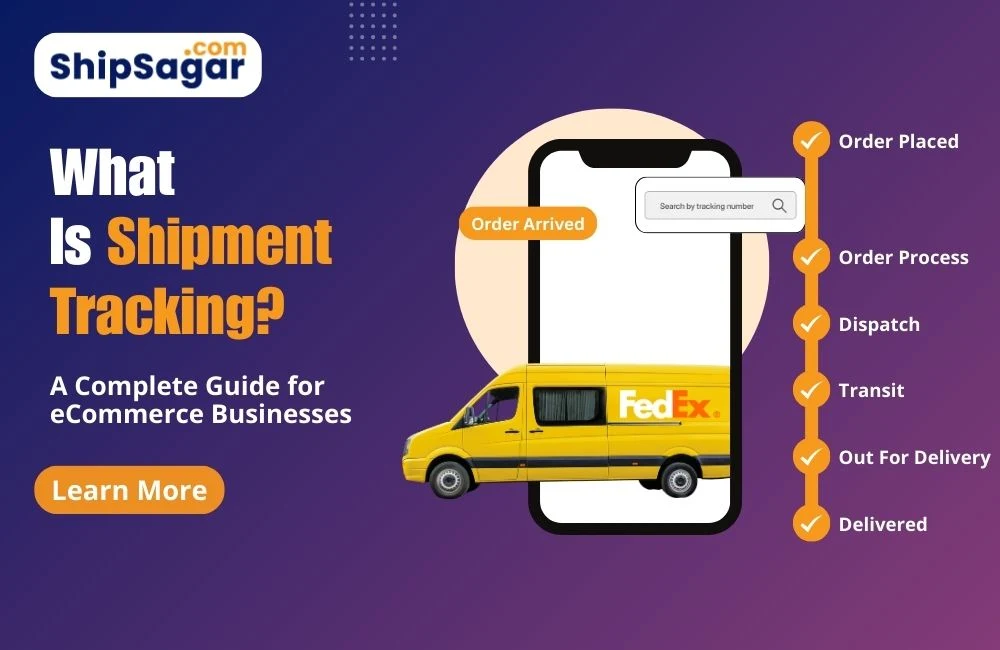
• Pickup confirmation from the seller’s warehouse
• Barcode scans at every courier hub and sorting facility
• In-transit movement across cities and states
• Out-for-delivery (OFD) status updates
• Delivery confirmation with timestamp
• Return-to-Origin (RTO) and Non-Delivery Report (NDR) alerts
What Parcel Tracking Is NOT:
It is important to clarify some common misconceptions:
| Misconception | Reality |
| Tracking = just a tracking number | Tracking is a full system – barcode, scan, update, notification, dashboard. |
| Only useful for customers | For businesses, tracking data reduces RTOs, improves carrier decisions, and cuts support costs. |
| Only works for big brands | Even small sellers shipping 50 orders/day need systematic tracking to avoid WISMO calls. |
| Tracking stops at delivery | Modern platforms track returns, RTOs, and exceptions too – full lifecycle visibility. |
How Does Parcel Delivery Tracking Work? (Step-by-Step Process)
Understanding the technical process behind parcel tracking helps eCommerce businesses appreciate why some systems work better than others. Here is a complete, step-by-step breakdown of how a parcel is tracked from order placement to delivery in India:
Step 1: Order Confirmation and AWB Generation
When a seller confirms a shipment, the courier system generates an AWB number (Air Waybill number) – also called a tracking number or consignment number. This is a unique alphanumeric code that acts as the digital identity of that parcel.
| Real Example: A Bangalore-based D2C skincare brand ships an order via Delhivery. Delhivery generates AWB number 1234567890. This number is printed as a barcode on the shipping label attached to the parcel. From this point, every scan is linked to this AWB. |
Step 2: Pickup Scan at Seller’s Location
The courier executive visits the seller’s warehouse or pickup address and scans the parcel’s barcode. This scan triggers the first tracking update: ‘Shipment Picked Up.’ The timestamp, pickup location, and courier executive ID are all logged in the courier’s tracking system simultaneously.
Step 3: Hub and Sorting Facility Scans
The parcel travels through multiple courier hubs and sorting facilities – these are intermediate checkpoints where shipments are sorted by destination. Every time the parcel arrives or departs from a hub, a barcode scan updates the tracking status.
For example, a parcel going from Delhi to Chennai might be scanned at:
1. Delhi Origin Hub (scan: ‘Shipment dispatched from origin’)
2. Delhi Airport / Rail Hub (scan: ‘In transit’)
3. Chennai Sorting Center (scan: ‘Arrived at destination hub’)
4. Chennai Local Delivery Branch (scan: ‘Out for Delivery’)
Step 4: Last-Mile Delivery and Proof of Delivery
The final leg of the journey – called last-mile delivery – is when the courier executive delivers the parcel to the buyer’s address. Upon successful delivery, the system captures:
• Delivery timestamp
• Delivery location GPS coordinates
• Recipient’s signature or OTP confirmation
• Photo proof of delivery (POD) – increasingly standard in 2026
Step 5: Automated Customer Notification
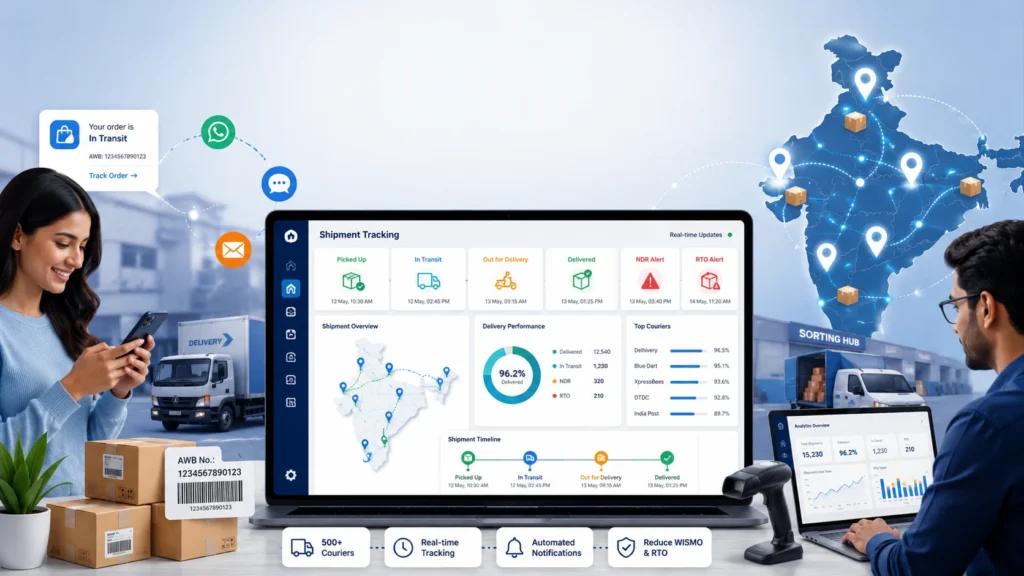
Alongside every scan, automated notifications are sent to the customer via Email, SMS, and WhatsApp – keeping them informed without any manual effort from the seller’s team.
| Why This Matters for Businesses: Each scan and notification reduces the chance of a customer calling your support team. If a parcel is scanned ‘Out for Delivery’ and the customer gets a WhatsApp notification, they are not going to WhatsApp you asking ‘Where is my order?’ – saving your team time and your business money. |
Types of Parcel Tracking Systems – Which One Does Your Business Need?
Not all parcel tracking systems are the same. Depending on the size of your business and the number of courier partners you work with, different types of tracking systems serve different needs:
Type 1: Single Courier Tracking (Manual)
The most basic form – you go to the courier company’s website, enter the AWB number, and check the status manually. Works for very small sellers shipping a handful of orders per day.
| Limitation: If you ship with 3 different couriers, you must check 3 different websites. For 100 shipments a day across Delhivery, Blue Dart, and DTDC, this means hundreds of manual checks – completely unscalable. |
Type 2: Courier Aggregator Tracking
Platforms like Shiprocket or Courier Mitra allow sellers to ship through multiple couriers and track orders within their platform. However, tracking is often limited to shipments dispatched through that aggregator – giving you partial visibility.
Type 3: Multi-Courier Tracking Software (Recommended)
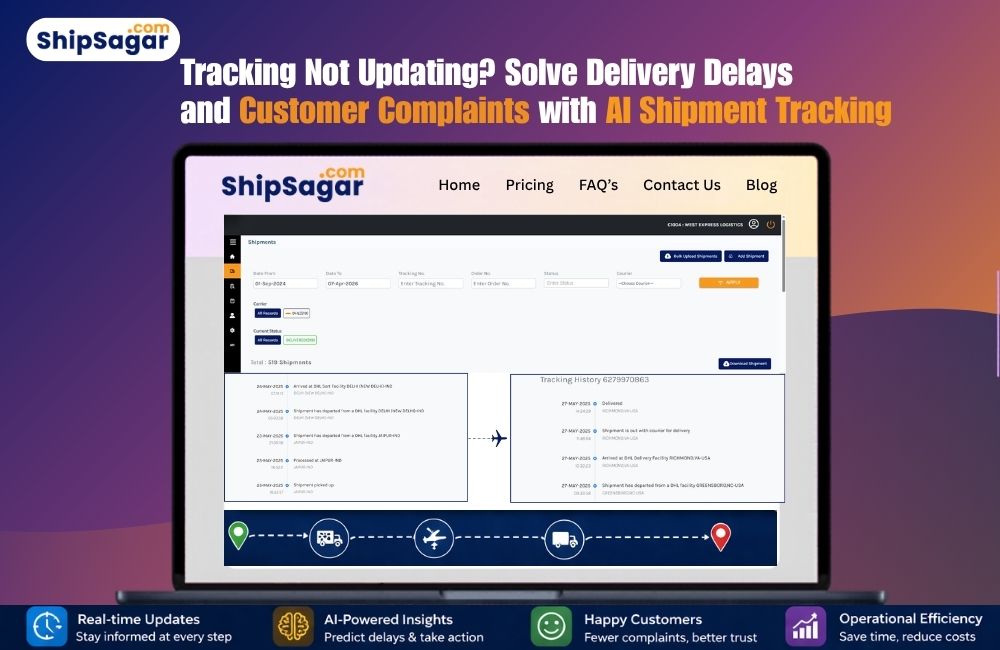
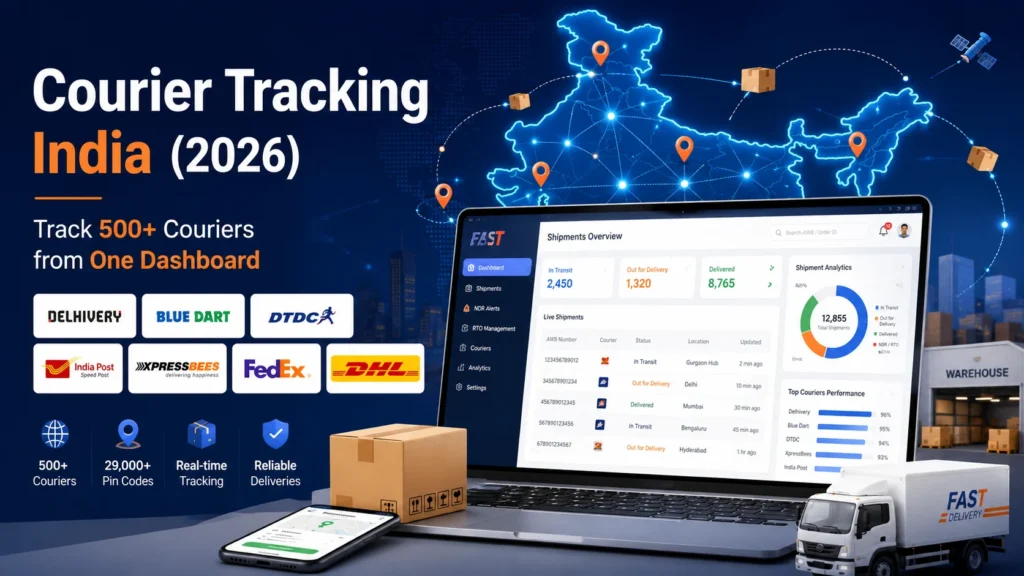
Multi-courier tracking software – like ShipSagar – connects directly to courier APIs and pulls real-time tracking data from 500+ couriers into a single, unified dashboard. You can track every shipment – regardless of which courier it was shipped with – in one place.
This is the gold standard for any eCommerce brand or logistics team managing significant shipment volumes.
| Feature | Manual Tracking | Aggregator Tracking | Multi-Courier Software (ShipSagar) |
| Couriers Covered | 1 courier | Limited to their partners | 500+ couriers |
| Automation | None | Partial | Full |
| Customer Notifications | Manual | Limited | Email (included) + SMS* + WhatsApp* (add-ons available) |
| Dashboard Analytics | None | Basic | Advanced carrier analytics |
| Branded Tracking Page | No | No | Yes – Tracking Page – ShipSagar domain (included) | Branded Page* (custom domain, paid add-on) |
| Suitable For | Micro sellers | Small-mid sellers | All business sizes |
Type 4: API-Based Custom Tracking
Large enterprises or marketplace platforms may build their own tracking interfaces using a Shipment Tracking API. This allows full customisation – embedding tracking within their own app or website. ShipSagar offers a REST API with webhook support for exactly this use case.
Common Parcel Tracking Statuses – Explained With Real Examples
One of the most frequent sources of customer confusion – and WISMO queries – is unclear tracking statuses. Here is a plain-language explanation of every status your customers will see, with real-world context:
| Tracking Status | What It Means | Common Customer Question It Triggers |
| Order Received / Pickup Pending | Courier has accepted the shipment booking but not yet physically picked up the parcel. | “Why hasn’t it moved yet?” |
| Shipment Picked Up | Courier executive has collected the parcel from the seller’s warehouse. | “Great, when will it arrive?” |
| In Transit | Parcel is moving through courier hubs toward the destination. | “It’s been 2 days – is it stuck?” |
| Arrived at Destination Hub | Parcel has reached the courier’s sorting facility in the delivery city. | “It’s in my city now – when delivered?” |
| Out for Delivery (OFD) | Courier executive has the parcel and is on the way to the buyer’s address. | “I need to be home – when exactly?” |
| Delivered | Parcel successfully handed over to the recipient. | No query – happy customer! |
| Delivery Attempted / Failed | Delivery tried but failed – customer unavailable, wrong address, access issue. | “Why wasn’t I notified before coming?” |
| NDR (Non-Delivery Report) | Multiple delivery attempts failed. Action needed from seller or buyer. | “What happens to my order now?” |
| RTO Initiated | Parcel is being returned to the seller – NDR unresolved. | “Did my order get cancelled?” |
| RTO Delivered | Parcel returned to the seller’s warehouse. | The seller needs to issue a refund or reship. |
| Exception / Stuck | Something went wrong – weather, customs, wrong scan, etc. | “Where is my order? It’s been a week!” |
| Pro Tip for eCommerce Brands: Most WISMO queries are triggered by the ‘In Transit’ and ‘Delivery Attempted’ statuses – because customers don’t understand what they mean. Adding human-friendly language to your branded tracking page (e.g., ‘Your package is on its way – expected by tomorrow’) dramatically reduces support tickets. |
Why Parcel Delivery Tracking Is Business-Critical – Not Just a Nice-to-Have
Many early-stage eCommerce founders treat parcel tracking as a secondary feature – something they will ‘set up later.’ This is a costly mistake. Here is why systematic parcel tracking directly impacts your bottom line:
1 Reducing WISMO Queries – and Their Hidden Cost
Every WISMO call costs money – not just in customer support salaries, but in the opportunity cost of your team’s time. Industry data suggests that handling one WISMO ticket costs an average of ₹50–₹150 in support time. If you are handling 200 orders a day with a 25% WISMO rate, that is 50 tickets/day – potentially ₹2,500–₹7,500 per day in avoidable support costs.
| ShipSagar Case Study: HYPD, a fast-growing lifestyle brand, reduced WISMO support queries by over 60% within the first month of using ShipSagar’s automated Email, SMS, and WhatsApp notifications. Customers no longer had to call – they already knew where their order was. |
2 Reducing RTOs – Protecting Your Revenue
Return-to-Origin (RTO) shipments are one of the biggest hidden costs in Indian eCommerce. When a parcel cannot be delivered and is returned, you pay double shipping – once forward, once reverse – plus the product sits in limbo, delaying refunds and impacting cash flow.
Proactive parcel tracking solves this by:
• Alerting you the moment a delivery is attempted and fails
• Enabling you to contact the customer before the second attempt
• Flagging at-risk RTOs early – before they become confirmed returns
3 Building Post-Purchase Customer Trust
The post-purchase experience – the period between ‘Order Confirmed’ and ‘Delivered’ – is one of the most anxiety-ridden moments in a buyer’s eCommerce journey. Brands that proactively communicate during this window build disproportionately higher customer loyalty.
| Research Insight: 60% of shoppers say a good delivery experience encourages them to purchase again (IMRG, 2025). Parcel tracking is the single biggest lever in the post-purchase experience – and it costs a fraction of what customer acquisition does. |
4 Carrier Performance Analytics – Smarter Logistics Decisions
When you track all your shipments in one dashboard, you start seeing patterns:
• Which courier has the highest RTO rate for orders in Tier 2 cities?
• Which carrier delivers fastest for COD orders in Maharashtra?
• Which courier has the most ‘In Transit Stuck’ exceptions in festive season?
This data is gold. Brands that use carrier analytics to inform their courier allocation strategy consistently lower their logistics costs and improve delivery SLAs – without changing their products or pricing.
5 Enabling a Branded Customer Experience
When a customer clicks on a tracking link and lands on a Delhivery or Blue Dart page, they have left your brand. But when your branded tracking page – with your logo, your colors, your domain – shows them where their order is, that is a brand touchpoint you own.
This matters more than most founders realize. Every time a customer interacts with your branded tracking page, it reinforces brand recall and subtly communicates product recommendations or ongoing offers.
Key Challenges in Parcel Tracking – And How to Solve Them
Even with good intentions, many Indian eCommerce brands struggle with parcel tracking. Here are the most common challenges and their practical solutions:
Challenge 1: Managing Multiple Courier Partners
The Problem: You work with Delhivery for metro cities, Blue Dart for premium shipments, and India Post for remote pincodes. Each has its own portal, its own login, and its own tracking format. Checking 5 courier portals manually for 300+ shipments a day is impossible.
The Solution: A multi-courier tracking platform like ShipSagar aggregates tracking data from all your courier partners via API – giving you a single dashboard where you can see every shipment, every status, in real time.
Challenge 2: Delayed Tracking Updates
The Problem: Sometimes tracking statuses go silent for 24–48 hours – especially at courier hubs or during peak season. Customers notice this and immediately assume something is wrong.
The Solution: Choose a tracking platform that uses direct courier API integration (not screen-scraping), which ensures faster, more accurate updates. Also, proactively messaging customers during known delay windows (‘Your order is en route – expect a delay of 1 day due to weather in your region’) reduces panic significantly.
Challenge 3: High RTO Rates
The Problem: Indian eCommerce has one of the highest RTO rates globally – particularly for COD orders in Tier 2 and Tier 3 cities. RTO rates of 20–35% are common in certain categories.
The Solution: Early RTO detection via NDR reports and exception alerts. When a delivery attempt fails, you need to know immediately – so your team can contact the customer, update the address, or reschedule – before the parcel starts its return journey.
Challenge 4: Lack of Customer Communication
The Problem: Many sellers send just one notification (the initial ‘shipped’ email) and then expect customers to self-track. The result? Support tickets, low repurchase rates, and chargebacks.
The Solution: Automate milestone-based notifications via Email, SMS, and WhatsApp for every key status – Picked Up, In Transit, Out for Delivery, Delivered, and Failed Attempt. Done correctly, this eliminates most inbound WISMO queries without any manual effort.
Challenge 5: No Visibility Into Carrier Performance
The Problem: Most sellers choose courier partners based on rate negotiations alone – without data on actual delivery performance. This leads to high RTOs, customer complaints, and brand damage.
The Solution: Use carrier performance analytics to track delivery rate, RTO rate, average delivery time, and exception rate per courier. Then allocate shipments intelligently – better couriers for high-value orders, cost-effective carriers for bulk.
Parcel Delivery Tracking in India – Supported Couriers and Coverage
India has one of the most complex logistics landscapes in the world – with a mix of national couriers, regional specialists, hyperlocal players, and international carriers. Here is an overview of the major courier categories and how tracking works across them:
| Courier Type | Examples | Tracking Availability |
| National Express | Delhivery, Blue Dart, DTDC, XpressBees, Ecom Express, Shadowfax | Real-time via API – most reliable |
| Government Postal | India Post, Speed Post | Tracking available but updates can be slower |
| International Carriers | FedEx, DHL, UPS, Aramex, USPS, Royal Mail | Real-time international tracking |
| Regional / Hyperlocal | Trackon, Professional Couriers, Wow Express, Bombino | Varies by carrier – API integration varies |
| Emerging / Logistics Startups | Porter, Shadowfax, Borzo | App-based real-time tracking |
| ShipSagar Coverage: ShipSagar integrates with 500+ Indian and global courier partners – including all major carriers listed above – allowing businesses to track domestic and international shipments from a single dashboard. No need to log into multiple portals or build custom integrations for each courier. |
India Post Parcel Tracking – A Special Note
India Post – with over 155,000 post offices – is the only courier that reaches every pincode in India. For sellers targeting Tier 3, Tier 4, and rural markets, India Post’s Speed Post (which starts at ₹19 for local shipments) is often the only viable delivery option.
India Post tracking uses a 13-character alphanumeric consignment number (e.g., EE123456789IN). Tracking is available on indiapost.gov.in but can be slow to update. Integrating India Post into a multi-courier tracking platform gives you a unified view alongside faster private carriers.
How to Choose the Right Parcel Tracking Solution – 7 Non-Negotiables
With multiple tracking platforms available in India, how do you choose the right one? Here are seven factors every eCommerce brand must evaluate:
1. Courier Coverage: Does it support all the couriers you currently use? And the ones you plan to add in the next 12 months? A platform with 500+ courier integrations gives you room to grow.
2. Real-Time API Integration: Avoid platforms that rely on web scraping for tracking updates – they are slower and less reliable. Look for direct API integrations with courier systems for real-time, accurate status.
3. Automated Notifications: Email is not enough. Your tracking solution must support SMS and WhatsApp notifications – these are the channels Indian consumers actually respond to. Proactive, multi-channel communication is the standard in 2026.
4. Branded Tracking Page: Your customers should track orders on your website – not on a courier portal. A branded tracking page with your logo, colors, and domain is non-negotiable for serious D2C brands.
5. NDR and RTO Management: Does the platform alert you when deliveries fail? Can you download NDR reports? Can you act on exceptions before RTOs pile up? These features directly protect your revenue.
6. Carrier Performance Analytics: Look for dashboards that show delivered percentage, RTO percentage, average transit time, and exception rate per courier. This data transforms your logistics decision-making.
7. Pricing and Scalability: Pay-per-shipment pricing (like ShipSagar’s ₹2/shipment Growth Plan) is ideal for growing businesses – you pay for what you use, with no large upfront commitments. Watch out for platforms with hidden charges on notifications or API calls.
Modern Parcel Tracking – AI, Automation, and the Future of Shipment Visibility
Parcel tracking is no longer just about knowing where a package is – it is about predicting where it will be and acting on that intelligence proactively. Here is how the future of parcel tracking is unfolding in India and globally:
AI-Powered Delivery Predictions
Modern tracking platforms use machine learning models trained on historical carrier data to predict delivery timelines more accurately than the courier’s own estimates. Instead of ‘Expected delivery: 3–5 days,’ customers see ‘Expected delivery: Tomorrow, June 5th, between 2pm–6pm.’ This precision reduces anxiety and missed deliveries.
Proactive Exception Alerts
AI engines can detect anomalies – a parcel that has not been scanned for 36 hours, a cluster of RTOs from one pincode, a courier whose performance is declining. These alerts allow logistics teams to intervene before exceptions become crises.
WhatsApp-First Customer Communication
India is a WhatsApp-first country. Over 500 million Indians use WhatsApp daily. The shift from SMS to WhatsApp for delivery notifications is now happening at scale – with brands reporting 3–5x higher open rates for WhatsApp tracking updates versus email.
Branded Post-Purchase Commerce
The branded tracking page is evolving from a simple status display into a commerce touchpoint. Forward-thinking brands are embedding product recommendations, loyalty points updates, and referral offers on their tracking pages – monetizing a high-intent, high-attention moment in the customer journey.
IoT and Real-Time GPS Tracking
While GPS tracking is already standard for premium courier services and hyperlocal delivery, the integration of IoT sensors for temperature-sensitive shipments (pharmaceuticals, food, perishables) is growing rapidly in India. These smart shipments update location and environmental conditions in real-time.
How ShipSagar Solves Parcel Delivery Tracking for Indian Brands
Let us bring everything together with a clear picture of how ShipSagar addresses every challenge discussed in this guide:
| Challenge | ShipSagar Solution |
| Managing 5+ courier portals separately | Single dashboard for 500+ couriers – all tracking in one login |
| Drowning in WISMO support calls | Automated Email notifications at every milestone. SMS* and WhatsApp* available as paid add-ons. |
| Customers leaving your website to track orders | Tracking Page – ShipSagar domain (included) | Branded Page* (custom domain, paid add-on) |
| Late RTO detection and inventory loss | NDR reports and exception alerts – act before RTOs are confirmed |
| No data to make better courier decisions | Carrier analytics: Delivered%, RTO%, transit time per courier |
| High setup cost or technical complexity | No coding needed, setup in 5 minutes, starts free – ₹2/shipment |
How to Get Started with ShipSagar in 3 Steps
1. Create Free Account: Sign up at shipsagar.com – no credit card, no time limit. You get 50 free shipment tracking credits to start.
2. Add Your Shipments: Manually enter AWB numbers, bulk upload via CSV/Excel, or integrate via REST API for automated sync from your OMS or Shopify store.
3. Track, Notify, and Grow: ShipSagar auto-fetches live tracking from all your couriers, auto-sends customer notifications, and gives you the analytics to optimize your logistics operations.
| Pricing Snapshot: Free Plan: 50 shipments, lifetime free, no credit card needed. Growth Plan: Starts at ₹2 per tracked shipment – Email notifications, carrier analytics, NDR reports, REST API + webhooks, and tracking page on ShipSagar domain all included. SMS* and WhatsApp* notifications available as paid add-ons. Branded tracking page* (custom domain + logo) available as paid add-on. Volume discounts available – as low as ₹0.50/shipment for high-volume. No monthly fee. No contract. |
Conclusion – Tracking Is No Longer Optional
Parcel delivery tracking has evolved from a ‘nice-to-have feature’ into a core pillar of the post-purchase customer experience in Indian eCommerce. The brands winning in 2026 are the ones that have made tracking systematic, automated, and branded – not something they scramble to explain to frustrated customers.
Whether you are a D2C brand shipping 50 orders a day or a logistics team managing 50,000 – the ROI of getting parcel tracking right is measurable: fewer WISMO calls, lower RTO rates, higher repeat purchases, and a brand customers trust.
ShipSagar was built specifically for Indian eCommerce brands and logistics teams who want to move from chaos to clarity – tracking all shipments across all couriers, from one platform, starting free.
| Ready to take control of your parcel tracking? Start for free at shipsagar.com – 50 shipments, no credit card, setup in 5 minutes. Scale to unlimited shipments at just ₹2/shipment with all features included. |
Related Shipment Tracking Guides: