Most Indian eCommerce brands invest heavily in one thing: getting the customer to click ‘Buy Now’. Months of planning go into product photography, ad targeting, website UX, and checkout optimization. And then – the moment the customer completes the purchase – most brands go silent. No dispatch notification. No tracking update. No proactive communication. Just a generic ‘Your order is confirmed’ email and a wait that leaves the buyer wondering: “Did it actually ship? Where is it? Is it coming on time?” This silence is expensive. According to a 2025 Salesforce report, 88% of customers say the experience a company provides is as important as its products or services – and post-purchase interactions account for over 40% of overall brand perception. In Indian eCommerce, where repeat customers spend 67% more than first-time buyers (Harvard Business Review), the post-purchase experience is the single highest-ROI moment you are currently underinvesting in.
88% of customers say experience is as important as the product (Salesforce, 2025).
Customers with strong post-purchase experience spend 140% more over time (Metaport, 2026).
70% of customers say the delivery experience directly influences repeat purchases.
A 5% improvement in retention can boost profits by 25-95% (Bain & Company).
Average Indian DTC brand loses 70-77% of customers annually (Envive, 2026).
- What Is Post-Purchase Experience?
- The Post-Purchase Journey – Every Stage Mapped
- Why Post-Purchase Experience Matters More Than Ever in India (2026)
- Where Indian eCommerce Brands Are Falling Short
- The Real Business Impact – What the Data Says
- 8 Proven Strategies to Improve Post-Purchase Experience
- Post-Purchase Experience Metrics – What to Measure
- Reactive vs Proactive – The Core Mindset Shift
- Frequently Asked Questions
What Is Post-Purchase Experience?
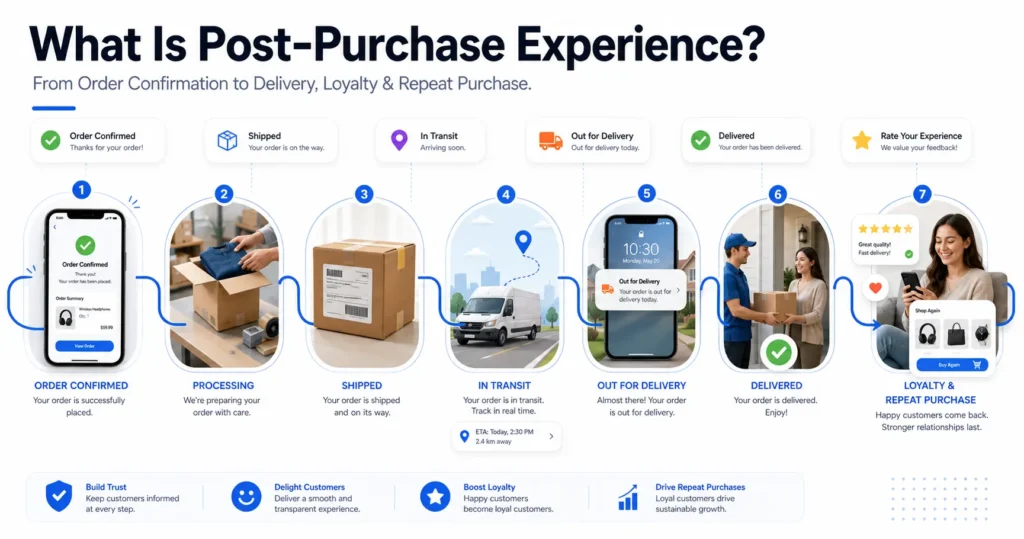
Post-purchase experience is everything that happens to a customer after they complete a purchase – from order confirmation through shipping, delivery, and any post-delivery interactions (returns, reviews, loyalty). It encompasses every touchpoint between the brand and the buyer during the period when the customer has paid but not yet received and evaluated what they bought. In eCommerce, this window – from checkout to delivered – is one of the most emotionally charged periods in the customer relationship. The customer has committed money. They are waiting. They have expectations. And every experience during this window either reinforces their decision to buy from you, or plants the seed of doubt that prevents them from buying again.
What Does Post-Purchase Experience Include?
| Stage | What It Covers | Key Customer Feeling |
| Order Confirmation | Order confirmation email/SMS, payment receipt, order summary | Relief + anticipation – ‘My payment went through’ |
| Pre-Shipment | Processing time, warehouse operations, dispatch preparation | Impatience – ‘When will it ship?’ |
| Shipping Notification | Dispatch notification, AWB sharing, tracking link | Re-engagement – ‘It’s on its way!’ |
| In-Transit Communication | Tracking updates, hub movements, estimated delivery | Anxiety -> calm (with updates) or WISMO (without) |
| Out-for-Delivery | OFD notification, delivery window, buyer availability | Excitement – ‘It’s coming today!’ |
| Delivery Moment | Delivery confirmation, proof of delivery, unboxing | Peak satisfaction (or disappointment if issues) |
| Post-Delivery | Product review request, loyalty points, cross-sell, returns | Loyalty vs one-time buyer decision point |
The Post-Purchase Journey – Every Stage Mapped for Indian eCommerce
Here is what a complete, well-managed post-purchase journey looks like for an Indian D2C brand:
- Order placed (T+0): Instant confirmation via email + WhatsApp. Order summary, expected delivery date, ‘What happens next’ message. Customer feeling: Reassured.
- Order processing (T+12-24 hours): Optional ‘We are packing your order’ update. Sets expectation that dispatch is imminent.
- Dispatched (T+24-48 hours): Dispatch notification via WhatsApp + Email with AWB number, courier name, and direct tracking link.
- In transit (T+2-5 days): Proactive transit update if on track, or delay notification if running late. No update = WISMO ticket. With update = Patient customer.
- Out for Delivery (Delivery day): OFD WhatsApp notification at 8-9 AM: ‘Your order is out for delivery today.’ Customer ensures availability. Feeling: Excited.
- Delivered (Delivery moment): Delivery confirmation notification with timestamp. Thank-you message. Optional review request. Feeling: Delighted.
- Post-delivery (T+3-7 days): Product review request. Loyalty points credited. Related product recommendation. Feeling: Valued – Repeat purchase likely.
| What Most Indian Brands Do The Reality Gap: Step 1: Generic ‘Order Confirmed’ email – most brands do this Step 2-6: Nothing – complete silence during delivery window Customer anxious -> contacts support -> WISMO ticket -> support cost After delivery: Nothing – missed brand moment – repeat purchase unlikely Result: 70-77% customer churn annually. Support costs Rs 4-15 lakh/year in avoidable WISMO tickets. |
Why Post-Purchase Experience Matters More Than Ever in India (2026)
1 Customer Acquisition Costs Are Surging
Meta and Google ad costs in India have risen dramatically. Acquiring a new customer now costs 5-7x more than retaining an existing one. When customer acquisition cost (CAC) is Rs 200-500 per order and a brand loses 70-77% of customers after the first purchase, the math is brutal. A better post-purchase experience that converts even 20% of one-time buyers into repeat buyers dramatically improves unit economics.
2 D2C Competition Has Intensified
Indian eCommerce now has thousands of D2C brands competing on product quality, price, and aesthetics. Post-purchase experience is one of the last remaining differentiation levers that is both meaningful to customers and underinvested by competitors. A brand that communicates proactively and resolves issues faster wins repeat purchases without additional ad spend.
3 WhatsApp Has Changed Customer Expectations
With 535.8 million WhatsApp users in India (DataReportal, Digital 2025), customers now expect direct, personal, real-time communication after every purchase. Brands using WhatsApp for post-purchase communication report significantly higher engagement and lower WISMO rates than those relying on email alone.
4 The COD Window Creates Unique Anxiety
For the 60-70% of Indian eCommerce orders placed on COD, the post-purchase anxiety is amplified – the customer has made no financial commitment yet but has a financial obligation coming. Proactive post-purchase communication – dispatch notification, transit updates, OFD alert – dramatically reduces COD cancellations and RTO rates.
5 Tier 2/3 India Drives Majority of Growth
India’s eCommerce growth is increasingly driven by Tier 2 and Tier 3 cities. These buyers often have less experience with eCommerce and higher anxiety about whether their order will actually arrive. Proactive post-purchase communication – especially on WhatsApp – reduces WISMO calls and builds trust in markets where brand trust is still being established.
Where Indian eCommerce Brands Are Falling Short
Based on ShipSagar’s experience with 1,000+ Indian eCommerce brands, these are the five most common post-purchase experience gaps:
| Gap | What Is Happening | Impact |
| No proactive notifications | Only dispatch email sent. No transit, OFD, or delivery confirmation. | WISMO queries: 30-50% of support volume |
| Courier portal redirect | Tracking link goes to Delhivery.com or Blue Dart.com – not seller’s site. | Lost brand touchpoint. Customer exits your ecosystem. |
| Email-only communication | Notifications sent via email only. Low open rates in Tier 2/3. | Missed reach. WhatsApp open rates 5x higher than email in India. |
| Late NDR response | Failed delivery discovered 2-3 days late. RTO already in process. | RTO costs: Rs 80-240 per order in double shipping fees |
| No post-delivery engagement | After delivery, complete silence. No review request, no cross-sell. | Repeat purchase rate drops. Loyalty opportunity missed. |
The Real Business Impact – What the Data Says
1 On Revenue
- 140% more spending over time from customers with strong post-purchase experience vs poor (Metaport research, 2026).
- 30-40% higher repeat purchase rates for brands with strong post-purchase engagement (Metaport, 2026).
- 67% more spending by repeat customers vs first-time buyers in the Indian market (Harvard Business Review).
- 25-95% profit boost from a 5% improvement in customer retention (Bain & Company).
2 On Support Costs
- 30-60% of all eCommerce support tickets are WISMO queries – almost entirely preventable with proactive notifications.
- 60-70% of all support tickets are post-purchase interactions – WISMO, return requests, delivery disputes (Claimlane research, 2026).
- A mid-size Indian D2C brand handling 2,000 orders/month with 30% WISMO rate spends approximately Rs 36,000/month on avoidable ‘Where is my order?’ support.
3 On Customer Retention
- 70% of customers say delivery experience directly influences repeat purchases (Metaport, 2026).
- Average DTC retention rate in 2026: just 31% (Loop Returns data). Well-performing brands achieve 45-55%. The gap is almost entirely explained by post-purchase experience quality.
| MATH The Math for a Mid-Size Indian D2C Brand: Current: 2,000 orders/month, 25% repeat rate, average order value Rs 800 Monthly repeat revenue: 500 orders x Rs 800 = Rs 4,00,000 After improving post-purchase experience (+8% repeat rate = 33%): Monthly repeat revenue: 660 orders x Rs 800 = Rs 5,28,000 Incremental monthly revenue: Rs 1,28,000 | Annual: Rs 15,36,000 ShipSagar cost: Starts at Rs 2 x 2,000 x 12 = Rs 48,000/year ROI: Rs 15,36,000 revenue increase on Rs 48,000 investment = 32x ROI |
8 Proven Strategies to Improve Post-Purchase Experience for Indian eCommerce Brands
Strategy 1 – Automate Multi-Channel Delivery Notifications (Highest Impact)
The single most impactful post-purchase improvement. Set up automated Email + SMS notifications at every delivery milestone – Dispatched, In Transit, Out for Delivery, Delivered, and Failed Attempt. WhatsApp notifications are available as an optional add-on (additional usage charges apply). For Indian customers, WhatsApp is the primary engagement channel (535.8 million users, DataReportal 2025) – Email + SMS reach buyers reliably; WhatsApp further amplifies engagement. Expected impact: 60-69% reduction in WISMO support queries (ShipSagar customer data). Customers who receive OFD notifications are significantly more likely to be available for delivery. -> Automated notifications across 500+ couriers: shipsagar.com/order-tracking-for-ecommerce/
Strategy 2 – Create a Branded Tracking Page on Your Domain
Every tracking link you send is a brand touchpoint. When that link goes to Delhivery.com, you have surrendered your most high-attention post-purchase moment to a courier. A branded tracking page – on your own domain, with your logo – keeps the customer in your ecosystem from checkout to delivery.
- Customers track on yourstore.com/track – not on delhivery.com
- Human-friendly status language instead of courier codes
- Post-purchase cross-sell and product recommendations on the tracking page
- Reduced WISMO – customers who can self-serve track do not contact support
| EXAMPLE Real Example – HYPD: HYPD implemented ShipSagar’s branded tracking page alongside automated notifications. Result: WISMO support queries dropped by over 60% within the first month. Customers now track orders on HYPD’s website – not on a courier portal – and the branded page drives additional product discovery. |
-> Set up your branded tracking page: Branded Tracking Page
Strategy 3 – Set Accurate Delivery Expectations at Checkout
- Use conservative, achievable estimates: If 70% of orders arrive in 4 days but 30% take 6-7, advertise 5-6 days. Customers love early deliveries; they hate late ones.
- Proactively notify about delays: When a delay is detected, send a notification before the customer notices. ‘Your order is running 1 day late – new expected delivery: Thursday’ eliminates the frustration.
Strategy 4 – Manage NDRs in Real Time (Not End-of-Day)
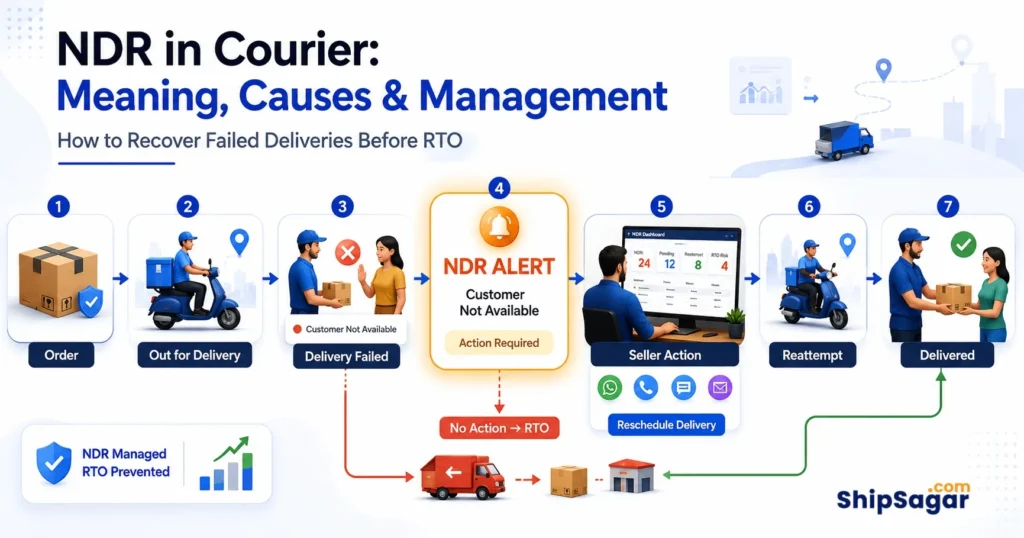
When a delivery attempt fails, the buyer experiences it as abandonment. Real-time NDR management: the moment a delivery attempt fails, your team is notified and can WhatsApp the customer within 1-2 hours with a rescheduling option. -> Complete NDR management guide: What Is NDR in Courier?
Strategy 5 – Send Delivery Confirmation + Next Step Message
The delivery confirmation moment is the highest-trust moment in the post-purchase journey. Use it to:
- Ask for a product review
- Invite them to a loyalty program
- Show a relevant related product recommendation
- Offer a next-purchase discount code with 7-day expiry
Strategy 6 – Make Returns Friction-Free
- Clearly state return policy at checkout AND in post-purchase communication: ‘7-day returns, no questions asked’ reduces buyer anxiety throughout the delivery period.
- Provide self-service return initiation: A customer who can initiate a return with two clicks will buy again. One who has to email support and wait 48 hours is often lost.
Strategy 7 – Use Post-Purchase Data to Improve Carrier Allocation
Your post-purchase experience data is also your logistics intelligence. Which courier has the highest delivery success rate in Maharashtra? Which carrier generates the most NDRs during festive season? Carrier analytics from ShipSagar should directly inform which couriers you use for which order types. Brands using carrier analytics see 5-12 percentage point improvements in first-attempt delivery rates.
Strategy 8 – Measure and Iterate on Post-Purchase NPS
Measure post-purchase NPS separately – send a ‘How was your delivery experience?’ survey 24 hours after delivery confirmation. The gap between checkout NPS and post-delivery NPS tells you exactly where post-purchase experience is losing customers.
Post-Purchase Experience Metrics – What to Measure
| Metric | What It Measures | Target Benchmark |
| WISMO Rate | % of orders generating ‘Where is my order?’ support contact. | < 5% (industry avg: 30-50%) |
| First Attempt Delivery Rate | % of shipments delivered successfully on first attempt. | > 80% for private couriers |
| NDR-to-RTO Conversion | % of failed deliveries that end up as RTOs. | < 40% (lower = better NDR management) |
| Post-Purchase NPS | Customer satisfaction score 24-48 hours after delivery. | > 50 is strong for Indian eCommerce |
| Repeat Purchase Rate (90-day) | % of first-time buyers who make a second purchase within 90 days. | > 25% is strong; avg DTC India ~15% |
| RTO Rate | % of shipments returned to sender – direct post-purchase failure indicator. | < 10% overall; < 20% COD-only |
| Support Tickets per 100 Orders | How many support tickets are generated per 100 orders fulfilled. | < 5 tickets per 100 orders is excellent |
Reactive vs Proactive – The Core Mindset Shift
| Reactive Post-Purchase (Most Brands) | Proactive Post-Purchase (Best Brands) |
| Wait for customer to ask ‘Where is my order?’ then answer. | Send delivery update before customer thinks to ask. |
| Discover failed delivery when parcel returns to warehouse. | Receive NDR alert within minutes. Contact buyer the same day. |
| Send tracking link to courier portal. | Branded tracking page – customer stays on your website. |
| Notify delay only when customer escalates. | Detect delay in dashboard -> notify customer before they notice. |
| Silence after delivery. No follow-up. | Delivery confirmation + review request + next-purchase incentive. |
| Support team: 40-50% time on WISMO tickets. | WISMO eliminated by proactive notifications. Support handles real issues. |
| Annual churn: 70-77%. One-time buyers never return. | Retention improves. Repeat buyers generate 67% more revenue. |
| SOLUTION ShipSagar – Post-Purchase Experience Infrastructure for Indian Brands: Automated Email + SMS at every milestone (WhatsApp available as optional add-on) Branded tracking page – your domain, your logo, customers stay on your website Real-time NDR alerts – catch failed deliveries before they become RTOs Carrier analytics – Delivered%, RTO%, NDR% per courier – optimize allocation 500+ Indian + global courier integrations – all shipments, one dashboard Free to start – 50 shipments lifetime free. Growth Plan: Starts at Rs 2/shipment. |
Related Guides on ShipSagar
Post-Purchase Operations Guides:
- What Is WISMO? How to Reduce ‘Where Is My Order’ Queries
- What Is NDR in Courier? Meaning, Causes & How to Manage
- What Is RTO in eCommerce? Complete Guide for Indian Sellers
- Courier Tracking India: Complete Guide
- Parcel Delivery Tracking: Complete Guide for Indian eCommerce Brands