India’s eCommerce logistics market has crossed a significant threshold in 2026. The sector is now valued at approximately USD 10.41 billion – growing at 15.5% CAGR toward USD 21.38 billion by 2031 (Nexdigm, 2026). The country’s logistics infrastructure is processing 12-14 million shipments every single day – a number that spikes to 150-200 million during festive sale events like Big Billion Days and Great Indian Festival. For Indian D2C brands, eCommerce sellers, and logistics teams, 2026 represents both the greatest opportunity and the most complex operational environment in Indian eCommerce’s history. Quick commerce has reset customer expectations. Tier 2 and 3 cities now account for 40.48% of the eCommerce logistics market (Mordor Intelligence, 2025). COD continues to dominate at 50-60% of orders. RTO rates remain 3x the global average. This guide covers the complete picture of Indian eCommerce logistics in 2026: market size, key trends reshaping logistics operations, the six major challenges every brand must address, and practical solutions – with a focus on what D2C brands and growing sellers can implement today.
Market size: ~USD 10.41 billion in 2026 – growing to USD 21.38 billion by 2031 (Nexdigm).
Daily shipments: 12-14 million per day; 150-200 million during festive peaks.
Tier 2/3 city share: 40.48% of total eCommerce logistics market.
COD share: 50-60% of orders – highest among major eCommerce markets.
India’s average RTO rate: 25-35% vs global benchmark of 8-12%.
Q-commerce share: ~20% of India’s eCommerce now dominated by Q-Commerce (ET Retail)
Online shoppers: 500+ million projected by 2026.
Fastest growing segment: Same-day delivery at 6.09% CAGR (2026-2031).
- India eCommerce Logistics Market – Size & Growth (2026)
- Who Is Driving India’s eCommerce Logistics Growth
- 7 Key Trends Reshaping eCommerce Logistics in India (2026)
- 6 Major Challenges in India’s eCommerce Logistics
- Solutions: How Indian D2C Brands Are Responding
- The Logistics Technology Stack for Indian eCommerce in 2026
- Frequently Asked Questions
India eCommerce Logistics Market – Size & Growth (2026)
India’s eCommerce logistics sector has undergone a structural transformation over the past five years. What was once a fragmented, largely unorganized market has consolidated around a handful of large-scale logistics players – while simultaneously opening up to hundreds of specialized regional and hyperlocal providers.
| Metric | 2025 | 2026 / Forecast |
| Market Size | ~USD 8.92 billion | ~USD 10.41 billion |
| CAGR (2026-2031) | – | 15.5% (Nexdigm, 2026) |
| Market by 2031 | – | ~USD 21.38 billion |
| Daily Shipments | ~10-12 million/day | 12-14 million/day |
| Online Shoppers | ~400-450 million | 500+ million projected |
| Tier 2/3 City Share | 38-40% | 40.48% (Mordor Intelligence) |
| Fashion & Lifestyle Share | ~25% | 25.58% – growing at 6.41% CAGR |
| B2C Share | ~60-62% | 62.58% of market (Mordor Intelligence) |
The North region dominated with 21.78% share in 2025 (Mordor Intelligence). The West is projected to post the fastest regional growth at 6.58% CAGR during 2026-2031 – driven by Maharashtra and Gujarat D2C brand expansion. The fastest-growing delivery segment is same-day delivery at 6.09% CAGR, reflecting the quick commerce impact on customer expectations.
Who Is Driving India’s eCommerce Logistics Growth
India’s logistics growth is being driven by five distinct forces – each with different implications for how brands and logistics providers operate:
1 Marketplace Giants (Flipkart + Amazon India)
Flipkart holds approximately 48% GMV market share and Amazon India 28-32%. Together, marketplace logistics (Ekart, Amazon Logistics) handles a significant portion of India’s daily shipment volume and sets service-level benchmarks that third-party sellers must match. Flipkart’s Big Billion Days and Amazon’s Great Indian Festival together generate 150-200 million shipments in the festive window alone.
2 Quick Commerce Platforms
Quick commerce now accounts for approximately 20% of India’s eCommerce and is valued at USD 6-7 billion in 2026 (ET Retail). Blinkit (Zomato), Swiggy Instamart, and Zepto together record over 8 million daily active users. Their sub-30-minute delivery promise has permanently reset customer delivery expectations across all eCommerce categories – not just groceries.
3 D2C Brands
India’s D2C ecosystem has grown dramatically – with thousands of brands selling directly to consumers via Shopify, WooCommerce, and their own apps. D2C brands collectively ship millions of orders daily via a mix of direct courier contracts, aggregators (Shiprocket, NimbusPost), and fulfillment services. D2C logistics is the fastest-growing, most complex segment – with the highest RTO risk and the greatest need for tracking technology.
4 Social Commerce and C2C
Social commerce – selling via Instagram, YouTube, and WhatsApp – is advancing at a 6.42% CAGR (2026-2031) (Mordor Intelligence). Individual creators, home-based sellers, and small entrepreneurs shipping via India Post and regional couriers represent a growing segment with unique tracking and logistics needs. C2C and social commerce sellers often have the least sophisticated logistics technology – creating significant opportunity for platforms like ShipSagar.
5 Tier 2/3 City Expansion
Tier 2 and 3 cities now represent 40.48% of the eCommerce logistics market. New internet users in small-town India are placing their first eCommerce orders – often on COD, often with incomplete addresses, often in zones with limited last-mile infrastructure. Serving these buyers profitably is the defining logistics challenge of Indian eCommerce in 2026.
7 Key Trends Reshaping eCommerce Logistics in India (2026)
Trend 1 – Quick Commerce Is Setting New Delivery Speed Benchmarks
Under-30-minute delivery in metro cities is no longer a differentiator – it is the expected baseline for FMCG, beauty, and essentials. Q-commerce has permanently elevated delivery speed expectations across all categories (Unicommerce, 2025). Even brands that do not sell via Blinkit or Zepto face customers who now compare delivery timelines against sub-30-minute Q-commerce benchmarks. The response: D2C brands are building dark store networks, partnering with hyperlocal delivery platforms, and investing in same-day dispatch workflows.
Trend 2 – AI-Powered Carrier Allocation and Route Optimization
2026 is the year AI-driven logistics automation moves from enterprise-only to accessible for growing brands. AI carrier allocation engines – which automatically route each shipment to the best-performing carrier based on pincode, delivery speed, and real-time performance data – are now available through platforms like ClickPost and ShipSagar’s carrier analytics. Brands using data-driven carrier allocation report 5-12 percentage point improvements in first-attempt delivery rates.
Trend 3 – Tier 2/3 City Last-Mile Expansion
Every major courier – Delhivery, XpressBees, Ecom Express, Shadowfax – is aggressively expanding Tier 2 and 3 coverage. Pincode serviceability has improved dramatically, with most private couriers now covering 20,000+ pincodes and India Post covering every pincode in India. However, last-mile quality in these markets remains variable – delivery success rates, tracking update frequency, and NDR management are all below metro standards.
Trend 4 – Multi-Carrier Strategy Is Now Standard
Single-courier dependency is a recognized risk in 2026. Most D2C brands above 500 orders/month now use 3-5 courier partners – allocating by zone, order type, and COD vs prepaid. This multi-carrier approach improves delivery success rates and reduces RTO, but creates a tracking complexity challenge: five courier portals, five different AWB formats, five different status update systems. Multi-courier tracking platforms like ShipSagar address this specific problem. -> Track all your couriers from one dashboard:
Trend 5 – Returns Logistics (Reverse Logistics) Getting Serious Attention
With India’s RTO rate at 25-35% and category-level rates reaching 40% in fashion, reverse logistics is now a strategic priority – not an afterthought. The reverse logistics market is growing alongside forward logistics. Brands are investing in: faster RTO processing and restocking, return-to-exchange conversions (where the buyer exchanges instead of returning), and analytics to identify which products, pincodes, and courier partners generate the most returns.
Trend 6 – Real-Time Tracking and Proactive Communication Are Table Stakes
Customers in 2026 expect proactive WhatsApp/SMS/Email notifications at every delivery milestone – not just a tracking number and an invitation to check the courier portal. Brands that communicate proactively report 60-69% fewer WISMO (Where Is My Order?) support tickets. ShipSagar customers who enable automated Email + SMS notifications see this reduction within the first 30 days of implementation.
Trend 7 – COD Still Dominates, But Prepaid Is Gaining Ground
COD continues to account for 50-60% of Indian eCommerce orders – but the trend is slowly shifting. Prepaid incentives (Rs 30-100 discount, free shipping, faster delivery) are converting COD buyers to prepaid at measurable rates in most categories. Each 10% shift from COD to prepaid reduces overall RTO rate by 2-3 percentage points. At scale, consistent prepaid incentive programs are the highest-ROI RTO reduction strategy available to Indian D2C brands.
6 Major Challenges in India’s eCommerce Logistics (2026)
Challenge 1 – High RTO Rate (25-35% vs Global Average of 8-12%)
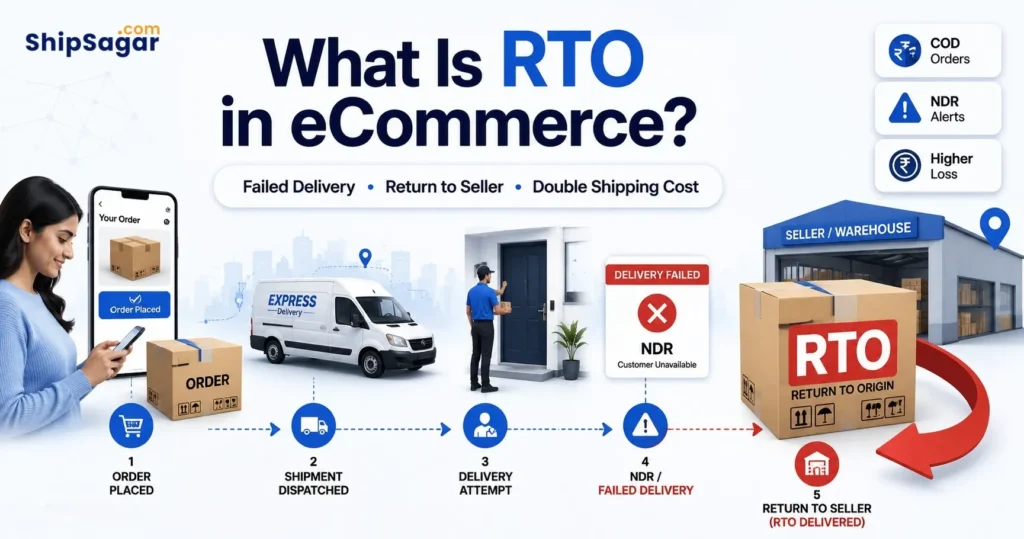
India’s Return to Origin problem is the most expensive structural challenge in Indian eCommerce logistics. According to GoKwik’s analysis across 180+ million shoppers, India’s average RTO rate is 25-35% – 3x the global benchmark. Indian D2C brands collectively lose over Rs 8,000 crore annually to RTO. The root causes – COD dominance, address infrastructure gaps, fake orders, high buyer-unavailable NDR rates – are all addressable with the right operational approach.
| SOLUTION RTO Solutions that Work in 2026: Address validation at checkout | Pre-dispatch COD confirmation WhatsApp | Prepaid incentives | Real-time NDR management via ShipSagar | OFD notifications | Pincode-level RTO analysis | Carrier performance reallocation |
-> Complete RTO reduction guide: How to Reduce RTO Rate
Challenge 2 – Last-Mile Delivery in Tier 2/3 Cities
Last-mile delivery is the most expensive and complex segment of eCommerce logistics – accounting for 50-70% of total logistics costs. In Tier 2/3 India, last-mile challenges are compounded by: incomplete street addressing, landmark-dependent navigation, limited courier coverage depth, language barriers between courier executives and buyers, and higher COD volumes that increase doorstep refusal risk. The solution involves a multi-courier approach: use private couriers for better-served Tier 2 cities, India Post for Tier 4 and rural pincodes, and ShipSagar to track all couriers from one dashboard with normalized status updates.
Challenge 3 – COD Complexity and Cash Flow
India’s COD infrastructure is uniquely complex. COD remittance cycles of 7-14 days from major couriers create significant working capital challenges for D2C brands – especially during festive season when order volumes spike 5-10x. A brand shipping 5,000 COD orders/day during Diwali with a 10-day remittance cycle has Rs 2-3 crore in transit cash that is operationally unavailable. Additionally, COD orders have ~26% RTO rate vs <2% for prepaid – meaning COD brands simultaneously deal with high shipping costs, slow cash remittance, and disproportionate RTO rates. The multi-pronged solution: faster remittance courier partners, consistent prepaid incentives, and pre-dispatch COD confirmation flows.
Challenge 4 – Festive Season Volume Spikes
India’s eCommerce festive season – October-November – generates 150-200 million shipments over 2-3 weeks. For courier networks, this creates hub congestion, sorting backlogs, and delivery delays that can push average transit times from 3-4 days to 7-10 days. For brands, this means: WISMO queries spike 3-5x, NDR rates increase as buyers refuse delayed deliveries, and customer satisfaction drops precisely when the highest-value first-time buyers are experiencing the brand. Proactive festive season logistics management: pre-festive carrier capacity confirmation, proactive delay notification workflows (‘Festival season may cause 1-2 day delay – your order is on time’), and pre-positioning inventory in regional fulfillment centers closer to high-demand zones.
Challenge 5 – Multi-Carrier Tracking Fragmentation
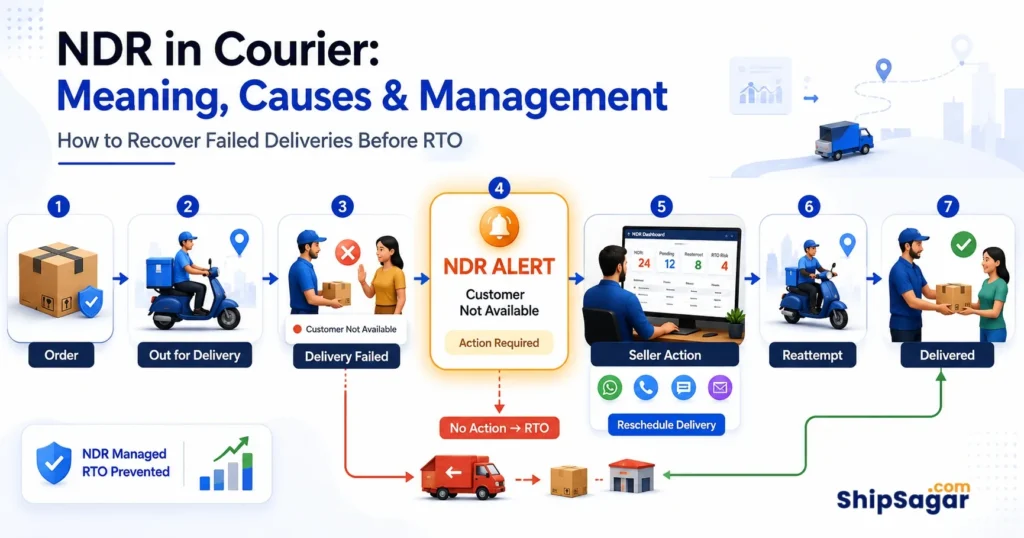
A D2C brand shipping 1,000 orders/day via Delhivery, Blue Dart, DTDC, and India Post is managing four courier portals, four different tracking status languages, four different NDR management workflows, and four different analytics dashboards simultaneously. This fragmentation costs operations teams hours daily in manual portal-checking, creates NDR blind spots (missing failed deliveries for 24-48 hours), and makes carrier performance comparison impossible without significant data engineering. ShipSagar solves this specific problem: 500+ courier integrations, one dashboard, auto carrier detection, unified NDR alerts, and per-courier analytics – all at Rs 2/shipment with no monthly fee. -> Unified multi-courier tracking:
Challenge 6 – Rising Logistics Costs
Courier rates in India have increased across carriers as infrastructure investment, fuel costs, and labor costs rise. For D2C brands, logistics costs now typically represent 8-15% of revenue – a significant margin pressure point. The compounding effect of rising forward shipping costs, high RTO rates (each generating double shipping cost), and NDR redelivery charges makes logistics cost management a top-3 business priority for most Indian D2C brands in 2026. Cost reduction levers: carrier rate negotiation (requires volume), routing optimization via carrier analytics, RTO reduction (each prevented RTO saves Rs 150-300), and prepaid conversion (eliminates COD fees of Rs 20-40 per order).
Solutions: How Indian D2C Brands Are Responding to 2026 Logistics Challenges
The brands winning in Indian eCommerce logistics in 2026 share a common operational approach – layered, data-driven, and technology-enabled:
| Challenge | What Struggling Brands Do | What Winning Brands Do |
| High RTO | Check courier portal end-of-day for returns | Real-time NDR alerts, COD confirmation, OFD WhatsApp, pincode analysis |
| WISMO queries | Answer each query manually on WhatsApp | Automated Email+SMS at every milestone, branded tracking page, self-serve tracking |
| Multi-courier fragmentation | Log into 4-5 courier portals daily | ShipSagar unified dashboard – all couriers, one login, real-time |
| Carrier performance | Allocate by rate card only | Carrier analytics – allocate by Delivered%, RTO%, transit time per zone |
| COD remittance | Accept 7-14 day cycles from all couriers | Prepaid incentives + COD confirmation + fast-remittance courier selection |
| Festive season spikes | React to delays when customers complain | Pre-festive planning, proactive delay notifications, regional inventory positioning |
The Logistics Technology Stack for Indian eCommerce in 2026
Here is the complete technology stack that best-in-class Indian D2C logistics operations use in 2026 – from order management to analytics:
| Layer | What It Does | Role in Logistics Excellence |
| eCommerce Platform | Shopify, WooCommerce, custom storefront | Checkout, order management, customer data |
| OMS / ERP | Unicommerce, Vinculum, custom OMS | Order routing, inventory allocation, warehouse management |
| Shipping Aggregator | Shiprocket, NimbusPost (for sellers without direct contracts) | Label generation, carrier selection, rate comparison |
| Multi-Courier Tracking | ShipSagar – 500+ couriers | Unified tracking, NDR alerts, carrier analytics, customer notifications |
| Customer Communication | Email (base) + SMS + WhatsApp add-on | WISMO reduction, OFD alerts, NDR rescheduling |
| Returns Management | ClickPost Returns, Shiprocket Returns, custom flow | RTO processing, return-to-exchange, refund automation |
| Analytics | ShipSagar carrier analytics + platform data | Per-courier RTO%, Delivered%, transit time – carrier reallocation decisions |
| SHIPSAGAR Where ShipSagar Fits in the 2026 Logistics Stack: ShipSagar is the multi-courier tracking layer that sits on top of your existing logistics setup. No courier changes required. No OMS replacement needed. Works alongside Shopify, Shiprocket, direct courier contracts, and any combination. What ShipSagar adds: -> Unified tracking for all 500+ couriers from one dashboard -> Real-time NDR alerts – act before RTOs are confirmed -> Automated Email + SMS notifications (WhatsApp optional add-on) -> Per-courier carrier analytics – Delivered%, RTO%, transit time -> Branded tracking page on your domain Free to start: 50 shipments lifetime free. Growth Plan: Starts at Rs 2/shipment. |
-> ShipSagar multi-courier tracking: -> Parcel tracking complete guide: -> Courier tracking India:
Related Guides on ShipSagar
eCommerce Logistics Guides:
- What Is RTO in eCommerce? Complete Guide for Indian Sellers
- How to Reduce RTO Rate in eCommerce India: 10 Proven Strategies
- What Is NDR in Courier? Meaning, Causes & How to Manage
- What Is WISMO? How to Reduce ‘Where Is My Order’ Queries