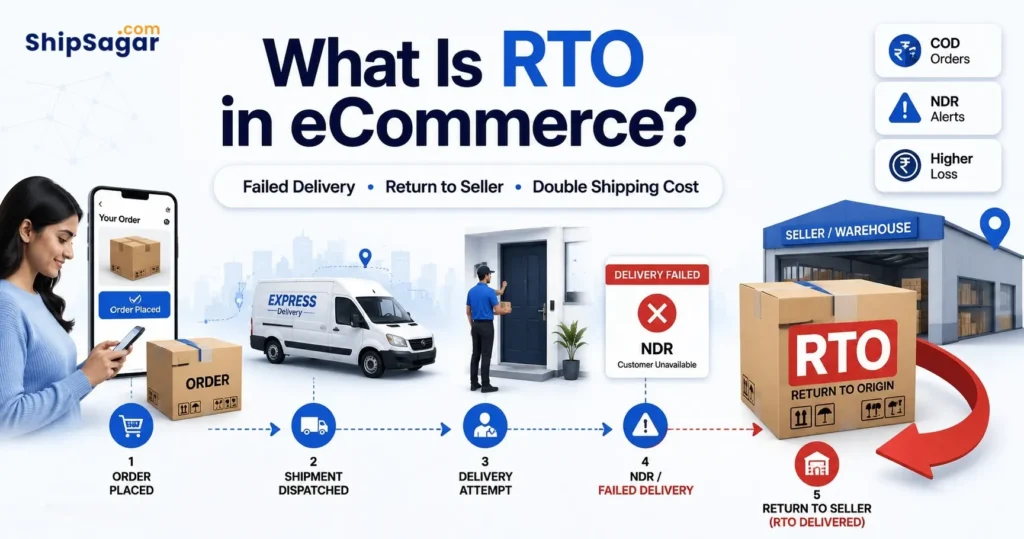
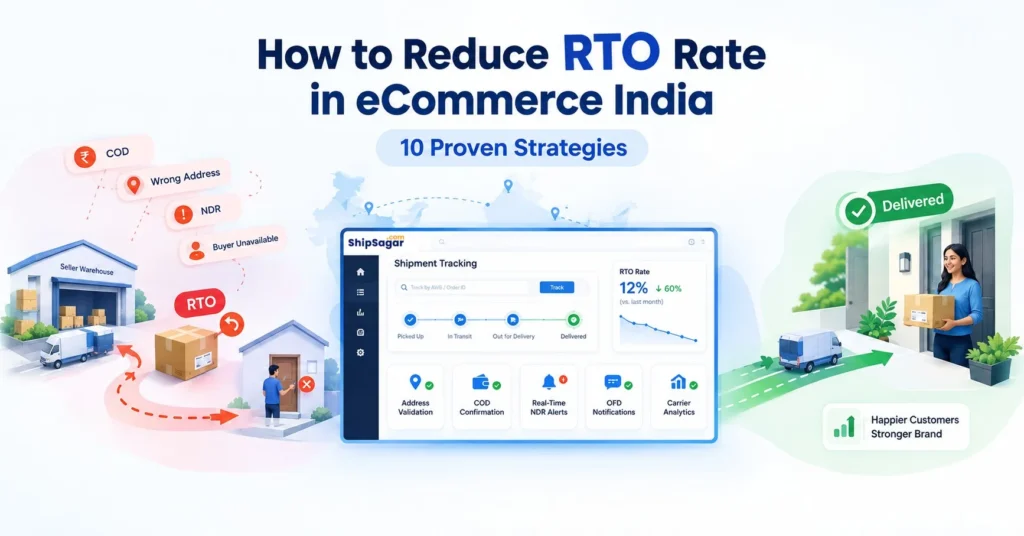
Every month, Indian eCommerce brands collectively lose over ₹8,000 crore to RTO (Return to Origin) – parcels that never reached the buyer and came back to the seller at double the shipping cost. According to GoKwik’s analysis across 180+ million Indian shoppers, India’s average RTO rate is 25-35% versus a global benchmark of 8-12%. That gap – 3x higher than global average – is not inevitable. It is fixable. The difference between a brand running at 39% RTO and one running at 15% is not a category difference or a courier difference. It is a handful of operational decisions made consistently. This guide covers all 10 of them – with specific implementation steps for Indian eCommerce brands and D2C sellers.
Average Indian eCommerce RTO rate: 25-35% (vs global benchmark of 8-12%).
COD orders: ~26% RTO rate | Prepaid orders: <2% RTO rate – a 13x gap.
Fashion and general merchandise: 30-40% RTO in some categories.
Each RTO costs seller Rs 150-300 in combined shipping, handling, and repackaging.
Indian D2C brands lose over Rs 8,000 crore annually to RTO (GoKwik, 2025).
Fast delivery (1-2 days): ~22% RTO – speed alone does not fix high RTO.
- Understanding RTO – Why India’s Rate Is 3x the Global Average
- The True Cost of RTO – Beyond Double Shipping
- RTO Root Causes – Where the Problem Actually Starts
- 10 Proven Strategies to Reduce RTO Rate in India
- RTO Reduction Timeline – What to Expect
- How ShipSagar Helps Reduce RTO
- Frequently Asked Questions
Understanding RTO – Why India’s RTO Rate Is 3x the Global Average
India’s RTO problem is structural – it is not caused by poor logistics alone. Three forces specific to Indian eCommerce create a fundamentally higher-risk delivery environment:
| Factor | Global eCommerce | Indian eCommerce |
| COD Share | 10-20% of orders | 60-70% of orders in Tier 2/3 cities |
| Address Infrastructure | Standardised postal codes, GPS mapping | Inconsistent, landmark-based, Tier 3 gaps |
| Buyer Intent at Order | Financial commitment at checkout (prepaid) | Zero commitment for COD – easy to refuse at door |
| Delivery Infrastructure | Dense urban networks, 1-2 day delivery | Sparse Tier 3/4 coverage, 4-8 day windows |
| Fraud / Fake Orders | Low – payment filters most fake orders | Significant – COD enables zero-risk fake orders |
The good news: every one of these factors has a countermeasure. The 10 strategies in this guide directly address each root cause – with specific tactics that Indian D2C brands use to bring RTO from 30%+ down to 12-18%.
The True Cost of RTO – Beyond Double Shipping
Most sellers calculate RTO cost as forward + reverse shipping. The real cost is significantly higher:
| RTO Cost Component | Per Order Cost | What It Means |
| Forward shipping | Rs 60-100 | Paid to send parcel to buyer |
| Reverse shipping (RTO fee) | Rs 60-100 | Paid to bring parcel back |
| COD handling charges | Rs 20-40 | Charged even on failed COD delivery |
| Repackaging / inspection | Rs 15-30 | Before product can be resold |
| Product damage (15-20% of RTOs) | Rs 0-500+ | Items returned damaged or missing |
| Inventory hold time | 3-5 week cash block | Product unavailable for resale during transit |
| Lost customer acquisition cost | Rs 150-500 (paid ads) | Ad spend wasted on customer who never converted |
| TOTAL per RTO (conservative) | Rs 150-300+ | Before accounting for brand damage or review impact |
| MATH RTO Cost Calculator – Real Example: Brand: D2C fashion brand, 1,000 orders/month, 28% RTO rate = 280 RTOs/month Forward shipping (280 x Rs 80): Rs 22,400 Reverse shipping (280 x Rs 70): Rs 19,600 COD fees (280 x Rs 30): Rs 8,400 Repackaging (280 x Rs 20): Rs 5,600 Lost CAC from paid ads (280 x Rs 200): Rs 56,000 Product damage estimate (56 units x Rs 300): Rs 16,800 Total monthly RTO cost: Rs 1,28,800 Annual RTO cost: Rs 15,45,600 After reducing to 15% RTO (150 RTOs/month): Rs 68,850/month Annual savings: Rs 7,19,400 |
RTO Root Causes – Where the Problem Actually Starts
Most sellers blame the courier when an order returns. The data tells a different story:
| # | Root Cause | % of RTOs | When It Starts |
| 1 | Wrong / incomplete address | 30-40% | At checkout – buyer enters incorrect details |
| 2 | Buyer unavailable at delivery | 20-25% | Post-dispatch – no OFD notification sent |
| 3 | COD refusal at doorstep | 15-20% | Pre-dispatch – low buyer intent at order time |
| 4 | Unreachable contact number | 10-15% | At checkout – wrong number entered |
| 5 | Fake / impulse COD orders | 5-10% | Pre-dispatch – no verification before shipping |
| 6 | Delivery delay (buyer cancels intent) | 5-10% | Post-dispatch – slow courier or peak season |
| 7 | Pincode not serviceable | 3-5% | At checkout – wrong courier selected |
| 8 | Product / packaging issue | 2-5% | Pre-dispatch – quality control failure |
Notice: over 60% of RTOs can be prevented before the parcel ever leaves your warehouse – through better checkout, COD verification, and pre-dispatch controls. The remaining 40% can be dramatically reduced through proactive delivery communication and NDR management.
10 Proven Strategies to Reduce RTO Rate in India
These strategies are ranked from highest to lowest upstream impact – address the highest-volume causes first:
Strategy 1 – Address Validation at Checkout (Fixes 30-40% of RTO Causes)
What it is: Adding automated address validation at your checkout page that flags incomplete or incorrect addresses before the order is placed. Why it matters: Wrong or incomplete address is the single largest cause of RTO in India – responsible for 30-40% of all failed deliveries. An address entered incorrectly at checkout cannot be fixed after dispatch without manual intervention that most operations teams miss. How to implement:
- Pincode validation: Validate that the pincode matches the city/state entered. Delhivery and other couriers have pincode APIs you can integrate at checkout.
- Required fields: Make apartment/flat number, building name, and landmark mandatory for non-plot addresses. A checkout that accepts ‘Delhi’ as a complete address will generate RTOs.
- Auto-complete: Google Maps Places API integration in checkout helps buyers select accurate addresses with a single click instead of typing freeform.
- Post-order address confirmation: For orders to high-RTO pincodes, send a WhatsApp: ‘Please confirm your delivery address: [address]. Reply YES to confirm or send corrected address.’
Expected RTO reduction: 15-25 percentage point reduction in address-related RTOs. Brands implementing checkout address validation report 20-30% overall RTO improvement.
Strategy 2 – COD Confirmation Before Dispatch (Eliminates Fake and Impulse Orders)
What it is: Sending an automated WhatsApp message or IVR call to every COD buyer after order placement – before the parcel is dispatched – asking them to confirm delivery intent. Why it matters: COD buyers have zero financial commitment at the time of ordering. Fake orders, impulse purchases, and ‘let me see when it arrives’ orders are all placed at no cost to the buyer. A confirmation step before dispatch filters these out before you pay even one rupee in shipping. How to implement:
- WhatsApp confirmation message (T+5 minutes after order): ‘Hi [Name]! Your order #[ID] for [Product] (Rs [Amount]) is confirmed for COD delivery to [City]. Reply YES to confirm OR NO to cancel. (No action = dispatch in 4 hours)’
- IVR call (if WhatsApp not delivered): Automated voice call within 30 minutes of order – ‘Press 1 to confirm your COD order of Rs [Amount], Press 2 to cancel.’ Industry data shows IVR confirmation reduces impulse RTOs by 20-25%.
- High-value threshold: For orders above Rs 1,000-2,000 (depending on your category), require confirmation before dispatch regardless of payment type.
Expected RTO reduction: 8-12% overall RTO improvement. Fake order elimination rate of 15-20% of unconfirmed orders. Best results for fashion, general merchandise, and lifestyle categories.
| EXAMPLE Real Implementation: A Shopify D2C brand in fashion sends a WhatsApp confirmation to every COD order via an automation. Orders that do not get a YES reply within 2 hours are held. Orders that get a NO are cancelled. Result: 12% reduction in RTO rate within 30 days, with zero impact on confirmed-intent orders. |
Strategy 3 – Prepaid Incentives (Highest Long-Term ROI)
What it is: Offering genuine financial incentives to buyers who choose prepaid over COD at checkout. This is the highest-ROI RTO reduction strategy because it addresses the root cause: COD orders have 26% RTO rate vs <2% for prepaid – a 13x difference. Converting even 20% of COD orders to prepaid can reduce total RTO rate from 28% to 20% or lower. Effective incentive structures:
- Prepaid discount (Rs 30-100): Clear, visible discount at checkout for UPI/card/netbanking. ‘Pay online and save Rs 50’ shown alongside the COD option. Most effective incentive across categories.
- Free shipping for prepaid: When COD carries a convenience charge, removing it for prepaid creates a natural pull. Even Rs 30 COD fee + Rs 30 prepaid savings = Rs 60 incentive.
- Faster delivery for prepaid: ‘Prepaid orders dispatch today. COD orders dispatch tomorrow.’ Buyers who want faster delivery self-select into prepaid.
- Post-NDR UPI switch: When a COD delivery fails (NDR), immediately send: ‘Unable to deliver your order. Click here to switch to UPI and we will attempt redelivery today.’ Converts failed COD delivery into prepaid at the highest-intent moment.
Expected RTO reduction: Each 10% shift from COD to prepaid reduces overall RTO rate by approximately 2-3 percentage points. Over 6-12 months, consistent prepaid incentives can shift COD-prepaid split from 70-30 to 50-50 in many categories.
Strategy 4 – Real-Time NDR Management (Saves Orders After Failed Delivery)
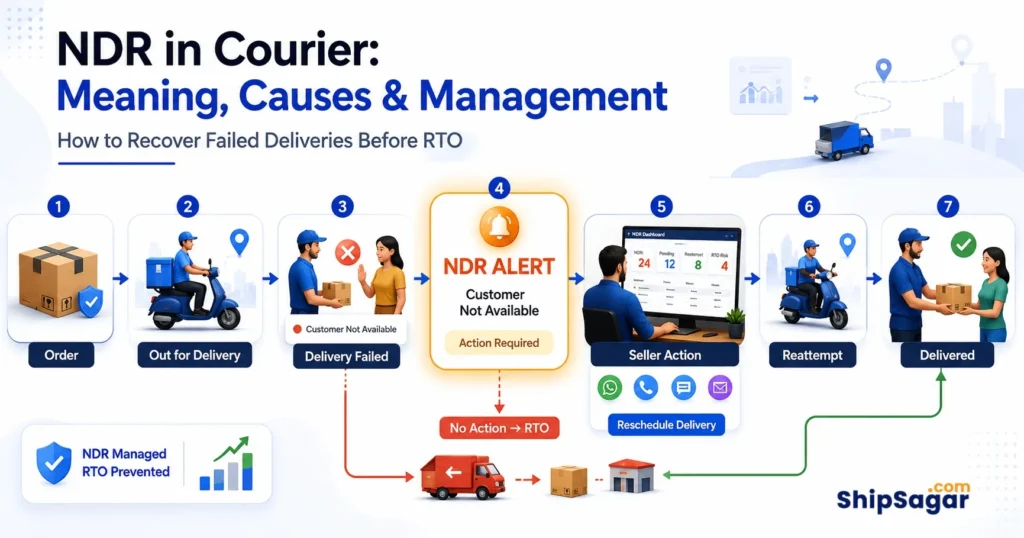
What it is: Receiving instant alerts when a delivery attempt fails (NDR), then contacting the buyer within 1-2 hours to coordinate redelivery before the courier initiates RTO. This is the most critical post-dispatch RTO prevention strategy. Every RTO starts as an NDR – but not every NDR has to become an RTO. The window between NDR generation and RTO initiation is 24-48 hours for most Indian couriers. Sellers who act within this window recover 40-60% of orders that would otherwise return. Implementation:
- Real-time NDR alerts: Use ShipSagar’s multi-courier tracking to receive NDR alerts from all your courier partners – Delhivery, Blue Dart, DTDC, India Post, and more – in one dashboard the moment a delivery attempt fails.
- Triage by reason code: ‘Customer Not Available’ – WhatsApp buyer with rescheduling link. ‘Wrong Address’ – request corrected address. ‘COD Refusal’ – offer UPI switch. ‘Phone Unreachable’ – try alternate contact or email.
- Response within 2 hours: Industry data shows buyer intent degrades significantly after 36 hours from a failed delivery. Acting within 2 hours of the NDR maximises redelivery success rate.
- Download weekly NDR reports: Analyse patterns – which pincodes generate most NDRs, which courier generates most fake delivery attempts, which day of week has highest failure rates.
Expected RTO reduction: Brands with structured NDR response systems reduce NDR-to-RTO conversion from 60-70% to 30-40%. At 200 NDRs/month, this saves 60-80 RTOs/month. -> Complete NDR management guide: What Is NDR in Courier?
Strategy 5 – Out-for-Delivery WhatsApp Notifications (Reduces ‘Buyer Unavailable’ RTOs)
What it is: Sending an automated OFD (Out for Delivery) notification via WhatsApp to the buyer at 8-9 AM on the delivery day – before the courier executive starts their route. ‘Buyer not available’ is responsible for 20-25% of all RTOs and NDRs. The fix is simple: if the buyer knows the parcel is coming today, they will be home or arrange for someone to receive it. An OFD WhatsApp notification sent at 8-9 AM on delivery day gives buyers enough notice to adjust their plans. Message template: ‘Hi [Name]! Your [Brand] order is out for delivery today. Expected arrival: between 10 AM – 6 PM at [Address]. Please ensure someone is available. AWB: [AWB]. Track here: [link]’ Expected RTO reduction: 15-25% reduction in ‘buyer unavailable’ NDRs. Since this cause accounts for 20-25% of all RTOs, OFD notifications contribute a 3-6 percentage point overall RTO improvement.
Strategy 6 – OTP Verification for High-Risk COD Orders
What it is: Requiring buyers to complete a one-time password (OTP) verification step for COD orders above a defined value threshold. OTP verification creates a friction point for low-intent and fake COD orders – while barely affecting genuine buyers who are happy to verify a legitimate purchase. The phone number validation that comes with OTP also eliminates orders with wrong contact numbers – the 4th largest RTO cause. How to implement:
- OTP at checkout: For COD orders above Rs 500-1,000 (category-dependent), require mobile OTP before order confirmation.
- OTP on confirmation message: After order placement, send OTP on the confirmation WhatsApp: ‘Reply with OTP [XXXX] to confirm your order. Not you? Ignore this message.’
- Risk scoring: Flag orders with multiple COD orders from the same phone number, orders to non-residential addresses, or orders from pincodes with >35% historical RTO for additional verification.
Expected RTO reduction: Brands using OTP verification for COD orders above Rs 500 report 8-15% overall RTO improvement. Fake order elimination rate of 60-70% on flagged high-risk orders.
Strategy 7 – Pincode-Level RTO Analysis (Identify and Act on High-RTO Zones)
What it is: Downloading your RTO data by pincode, identifying the 10-15 pincodes responsible for a disproportionate share of your returns, and taking targeted action on those specific zones. In most Indian eCommerce brands, 3-5 pincodes account for 20-30% of total RTOs. These pincodes may have weak courier coverage, concentrated fake order activity, or address infrastructure problems. Identifying and acting on them has outsized impact on overall RTO rate. What to do with high-RTO pincodes:
- Disable COD for specific pincodes: Pincodes with >35% RTO rate on COD should be prepaid-only. Accept only UPI/card for those zones.
- Switch courier for specific pincodes: If Delhivery has 40% RTO in a pincode but XpressBees has 18%, route all orders from that pincode to XpressBees using carrier analytics data.
- Enhanced verification for those zones: Add extra COD confirmation step or OTP requirement specifically for orders to high-RTO pincodes.
How to get the data: ShipSagar’s carrier analytics shows RTO rate by courier. Cross-reference with your OMS data by pincode. ShipSagar’s downloadable NDR reports can also be filtered by pincode.
Strategy 8 – Carrier Performance-Based Allocation (Reduce Courier-Caused RTOs)
What it is: Using carrier performance data to route shipments to couriers with the best delivery success rate for specific zones and order types – instead of routing based on price alone. Not all RTOs are caused by buyer behaviour. Courier-caused RTOs – fake delivery scans, poor last-mile coverage, excessive delivery delays – account for 10-20% of all RTOs at some brands. If Courier A has 18% RTO in Maharashtra but Courier B has 8%, routing Maharashtra orders to Courier B is the single most impactful per-shipment change you can make. How to get this data: ShipSagar’s carrier analytics dashboard shows per-courier Delivered%, RTO%, average transit time, and exception rate – broken down by geography. Use this monthly to adjust your courier allocation rules. Expected RTO reduction: Switching from underperforming to better-performing couriers in specific zones typically delivers 3-8 percentage point RTO improvement in those zones within 30-60 days. -> Carrier analytics and multi-courier tracking:
Strategy 9 – Block Repeat RTO Customers
What it is: Identifying phone numbers or addresses that have generated RTOs for your brand in the past, and either blocking COD for them or requiring OTP/prepaid for repeat orders. A measurable percentage of Indian eCommerce RTOs come from serial refusers – buyers who consistently place COD orders with no intent to accept. Tracking these patterns and blocking them at the order level eliminates a recurring RTO source at zero cost. Implementation:
- RTO blacklist by phone: Any phone number that has generated 2+ RTOs on your store in 90 days is flagged. Their next COD order requires OTP confirmation or prepaid.
- Address blacklist: Addresses with 2+ RTOs are flagged for enhanced verification on next order.
- Marketplace seller blacklist: On marketplaces, buyer accounts with high refusal rates are often identifiable through platform data – use this where available.
Expected RTO reduction: For brands with 6+ months of data, blocking repeat RTO customers typically eliminates 5-10% of total RTOs.
Strategy 10 – Packing Videos for High-Value Orders (Reduce Damage/Mismatch RTOs)
What it is: Recording a short video of the packing process for orders above a defined value threshold – showing the correct product being packed in good condition. While packing videos do not directly prevent RTO, they serve two critical functions: (1) They reduce doorstep refusals due to product mismatch when the video proves the correct item was sent. (2) They protect against false RTO damage claims in marketplace dispute resolution. Implementation:
- Record 30-60 second video for all orders above Rs 1,000-2,000
- Video shows: product label, product condition, packing process, sealed package with AWB visible
- Store videos tagged by order ID for 30 days minimum
- Share video proactively when buyer claims wrong item or damage
Expected RTO reduction: 2-5% overall RTO reduction from damage/mismatch category. Significant protection against marketplace chargebacks and false return claims.
RTO Reduction Timeline – What to Expect
Here is a realistic timeline for implementing these strategies and the RTO improvement you can expect at each stage:
| Timeline | Strategies to Implement | Expected RTO Impact | Effort Level |
| Week 1 | OFD WhatsApp notifications + COD confirmation message | 3-6% RTO reduction | Low – automation setup |
| Week 2-4 | Real-time NDR management system + NDR response SOP for team | Additional 4-8% reduction | Medium – process + tool |
| Month 2 | Address validation at checkout + OTP for high-value COD | Additional 5-10% reduction | Medium – tech integration |
| Month 3 | Pincode analysis + carrier reallocation + prepaid incentives | Additional 3-7% reduction | Low – data analysis |
| Month 4-6 | Repeat RTO blocking + packing videos + continuous optimisation | Additional 2-4% reduction | Low – ongoing |
| TOTAL (from 28% RTO) | All 10 strategies implemented and iterated | Target: 12-18% RTO | 10-16 point reduction |
| IMPORTANT Realistic Expectations: No single strategy eliminates RTO. Layered implementation of all 10 strategies delivers cumulative reduction. COD-heavy categories (fashion, general merchandise) have structural floors – 12-18% RTO is realistic even with excellent operations. Prepaid-first brands can achieve 5-8% overall RTO through consistent incentives over 6-12 months. Category benchmark: Fashion 15-25% optimal | Electronics 5-12% | Health/Supplements 5-10% |
How ShipSagar Helps Reduce RTO for Indian eCommerce Brands
ShipSagar addresses RTO through the post-dispatch layer – the 40% of RTOs that happen after the parcel ships:
| RTO Challenge | ShipSagar Solution |
| Late NDR detection | Real-time NDR alerts from 500+ couriers – act within hours, not days. |
| Buyer unaware of delivery day | Automated Email + SMS at OFD milestone (WhatsApp optional add-on) – buyer knows to be home. |
| No carrier performance data | Per-courier RTO% analytics by geography – identify and replace underperforming carriers. |
| Downloadable NDR reports | Filter by courier, date, pincode, reason code – weekly pattern analysis to fix upstream causes. |
| 5 courier portals to monitor | One dashboard for 500+ couriers – all NDRs, all RTOs, all tracking in one login. |
| No exception alerts | Automatic exception alerts for stuck shipments – proactively notify buyer before they ask. |
| CTA Start Reducing RTO Today – Free on ShipSagar: Track all shipments across 500+ couriers from one dashboard. Get real-time NDR alerts – act before RTOs are confirmed. Download NDR reports by courier, pincode, and reason code. Monitor per-courier RTO% and reallocate to better performers. Free Plan: 50 shipments, lifetime free, no credit card. Growth Plan: Starts at Rs 2/shipment. All features included. Start free at shipsagar.com |
Related Guides on ShipSagar
eCommerce Logistics Guides:
- What Is RTO in eCommerce? Complete Guide for Indian Sellers
- What Is NDR in Courier? Meaning, Causes & How to Manage
- What Is WISMO? How to Reduce ‘Where Is My Order’ Queries
- Courier Tracking India: Complete Guide