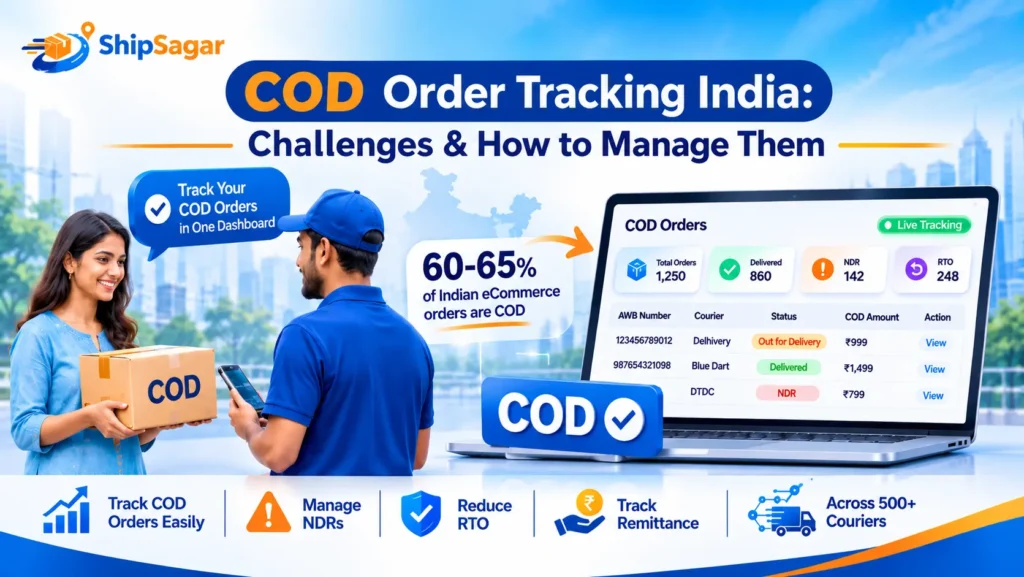
Cash on Delivery (COD) is not a legacy payment method that Indian eCommerce is slowly moving away from. It is the defining feature of Indian eCommerce – and in 2026, 60-65% of all eCommerce orders in India are still placed via COD (ET Prime Research, 2024). In Tier 2 and Tier 3 cities, that number climbs even higher. For brands on Meesho, over 75% of orders are COD.
COD creates a fundamentally different order management challenge from prepaid eCommerce. When an order is prepaid, the customer has committed their money – their intent to receive is high and RTO risk is low. When an order is COD, the customer has committed only their time and address – they can refuse delivery at the doorstep at zero cost to themselves. This asymmetry is why COD orders have 25-30% RTO rates vs 2-3% for prepaid – a 10-13x difference.
Managing COD orders in India requires a different operational approach from prepaid tracking: proactive communication before and during delivery, real-time NDR alerts, fast COD-to-prepaid conversion flows, COD remittance tracking, and carrier analytics specific to COD performance. This guide covers all of it.
| COD REALITY India COD Statistics 2026: 60-65% of all Indian eCommerce orders placed via COD (ET Prime Research, 2024) Meesho: 75%+ COD orders – 1 in 4 fails to reach the customer COD RTO rate: 25-30% vs prepaid RTO rate: 2-3% – a 10-13x gap Fashion COD RTO: can exceed 35-40% (Razorpay, 2026) India’s D2C market: ~USD 87.5 billion in 2025 – COD return rates directly impact |
1. How COD Order Tracking Differs from Prepaid Order Tracking
COD and prepaid orders follow the same physical delivery journey – same courier, same AWB, same tracking infrastructure. But operationally, they require completely different management approaches
| Dimension | Prepaid Order Tracking | COD Order Tracking |
| Buyer commitment | Money paid upfront – high intent to receive | Zero financial commitment – easy to refuse |
| RTO risk | 2-3% average RTO rate | 25-30% average RTO rate (10-13x higher) |
| Pre-delivery action | OFD notification recommended | Pre-dispatch confirmation + OFD notification – both critical |
| NDR urgency | Act within 48 hours | Act within 2-4 hours – COD refusal window is shorter |
| Payment tracking | Payment received at checkout – done | COD collected by courier at delivery – remittance tracked separately |
| Fraud risk | Payment filter eliminates most fake orders | Fake orders possible at zero cost to fraudster |
| Notification priority | Post-dispatch notifications important | Pre-dispatch COD confirmation + OFD + NDR – all critical |
The operational implication: a COD order requires 2-3x more active management than a prepaid order – at every stage from order confirmation to delivery to remittance reconciliation. Brands that treat COD orders identically to prepaid orders will have disproportionately high RTO rates and working capital challenges.
2. The 6 Unique Challenges of COD Order Tracking in India
Challenge 1 – High RTO Rate (25-30% Average, Up to 40% in Fashion)
This is the defining COD challenge. With no financial commitment at order time, COD buyers can refuse delivery for any reason – or no reason at all. Customers in India are aware that by choosing COD, they have the flexibility to reconsider their purchase decisions (Shiprocket, per Dazeinfo). They may continue searching for price discounts after placing an order and cancel if they find a better deal elsewhere.
Fashion, footwear, and general merchandise are worst affected – COD RTO rates of 35-40% are common in these categories. Brands like Myntra and Ajio have experimented with COD restrictions for repeat returners. For most D2C brands, reducing COD RTO requires a multi-layer intervention strategy
Challenge 2 – NDR Management Complexity for COD Orders
When a prepaid delivery fails, the buyer is motivated to resolve it – they have already paid. When a COD delivery fails, the buyer has no financial motivation to engage with rescheduling. COD NDR resolution requires faster, more persistent outreach
The three most common COD-specific NDR codes: (1) COD Refused at Doorstep – buyer declined to accept and pay. (2) COD Amount Not Ready – buyer did not have cash/exact change. (3) Customer Not Available – buyer was home when they chose COD but not home at delivery. Each requires a different resolution approach.
Challenge 3 – COD Remittance Tracking and Cash Flow
When a COD delivery succeeds, the courier collects cash from the buyer. That cash is then remitted to the seller – but not immediately. Most Indian couriers have 7-14 day COD remittance cycles. For a brand shipping 1,000 COD orders/day, this means Rs 30-50 lakh+ in collected COD cash is in transit at any given time – operationally unavailable.
During festive season, when order volumes spike 5-10x, COD remittance delays can block Rs 2-5 crore in working capital – significantly constraining a brand’s ability to restock inventory, run additional ads, or pay suppliers. Tracking which COD collections have been remitted vs which are pending is a reconciliation challenge that manual spreadsheets cannot handle at scale.
Challenge 4 – Fake and Impulse COD Orders
The zero-cost nature of COD orders makes them attractive for two types of problematic buyers: (1) Fraudsters – placing fake orders for competitor damage, inventory depletion (marketplace seller attacks), or personal harassment. (2) Impulse buyers who placed the order on a whim but have no genuine intent to purchase. Both categories generate RTOs at the seller’s expense.
Research suggests that 5-10% of COD orders in some categories are fraudulent or have no genuine delivery intent. At scale, this is a material business cost. The only mitigation is pre-dispatch verification – COD confirmation messages before the parcel ships.
Challenge 5 – Multi-Courier COD Tracking Fragmentation
Most D2C brands above 300 orders/day use 3-5 courier partners – each handling COD collections separately, with separate remittance cycles, separate NDR management portals, and separate cash reconciliation reports. Tracking COD collection status across Delhivery, Blue Dart, DTDC, and XpressBees simultaneously – knowing which orders have been paid, which collections are pending remittance, and which are stuck in NDR – requires either significant manual effort or a unified COD tracking system
Challenge 6 – COD-Specific Customer Communication Challenges
COD buyers are more likely to be in Tier 2/3 cities, less likely to check email, and more likely to use WhatsApp and receive SMS. Standard prepaid notification flows (email-first) are insufficient for COD order management. A COD buyer who does not receive an OFD notification may genuinely forget the parcel is coming today – leading to ‘Customer Not Available’ NDR that could have been prevented with a well-timed WhatsApp message.
3. COD Order Lifecycle – Every Stage and What Can Go Wrong
Here is the complete COD order lifecycle with the specific failure points at each stage:
| # | Stage | Status | COD-Specific Risk |
| 1 | COD Order Placed | Order Confirmed | HIGH RISK: Fake order, impulse purchase, no genuine intent |
| 2 | Pre-Dispatch Window | Processing | COD confirmation call/WhatsApp – last chance to filter low-intent orders before shipping cost is incurred |
| 3 | Dispatched | Shipped | Moderate risk. COD handling charge now applies regardless of outcome. |
| 4 | In Transit | In Transit | Delay risk – if delivery takes 6+ days, buyer’s intent may change. Proactive transit updates reduce cancellations. |
| 5 | Out for Delivery | OFD | HIGH RISK: Buyer not home (no OFD notification sent), COD cash not ready, buyer changes mind |
| 6A | Delivered | Delivered + COD Collected | COD amount collected by courier. Remittance pending (7-14 days). Track remittance status. |
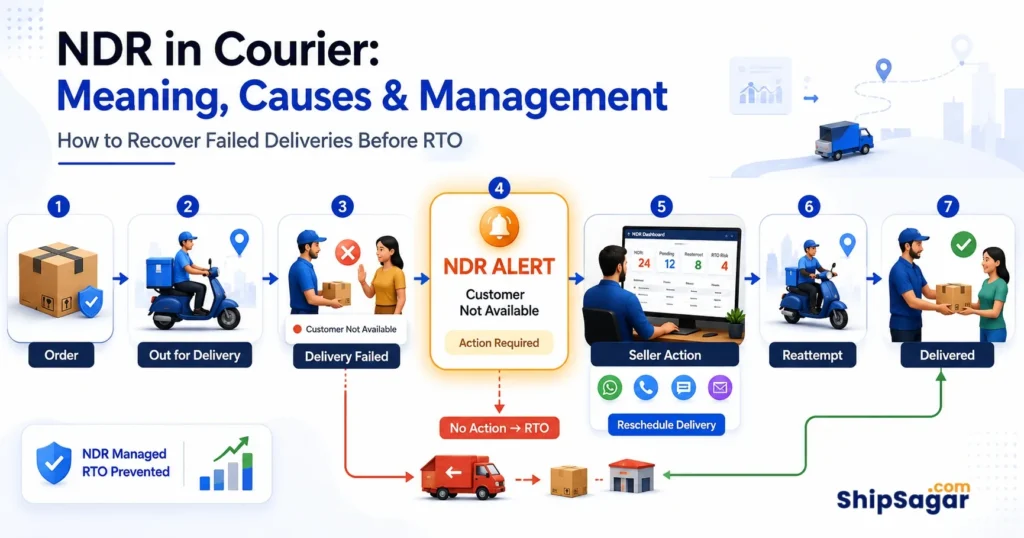
| 6B | NDR Generated | COD Refused / Not Available / Wrong Address | CRITICAL: 24-48hr window. Contact buyer within 2-4hrs. Offer UPI switch. Update address. Reschedule. |
| 7A | Reattempt Success | Delivered on Reattempt | Order saved. COD collected on reattempt. Remittance tracking begins. |
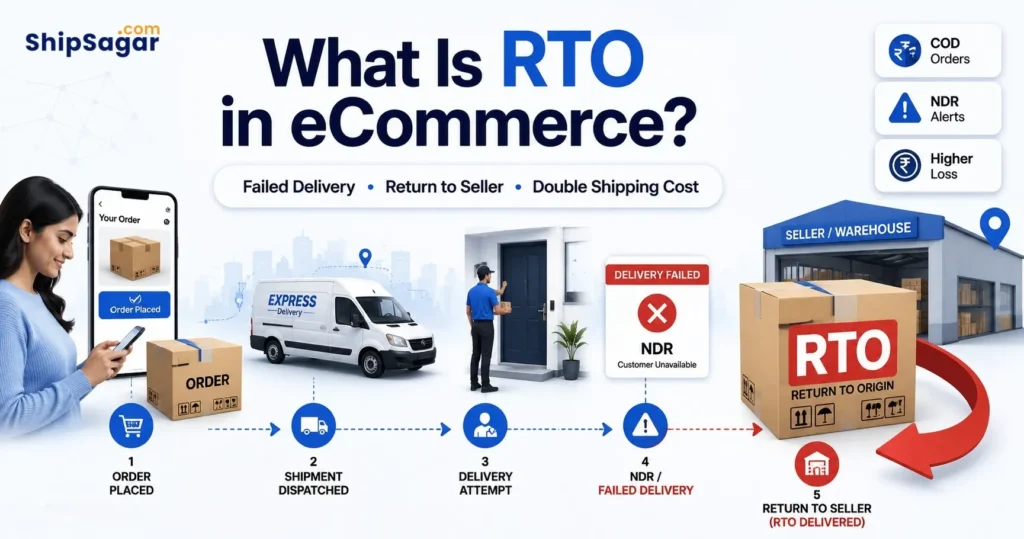
| 7B | RTO Initiated | Return to Origin | Total cost: Forward shipping + Reverse shipping + COD handling fee + Repackaging + Lost CAC. Rs 150-300 loss per order. |
4. COD Tracking Status Codes – What Each Status Means for COD Orders
Standard tracking statuses apply to COD orders – but here is how to interpret each status through the specific lens of COD management:
| Tracking Status | Standard Meaning | COD-Specific Implication |
| AWB Generated / Pickup Pending | Shipment booked. Courier not yet collected. | Best time to send COD confirmation if not already sent. |
| Picked Up / In Transit | Parcel with courier, moving toward destination. | Send transit update to keep buyer informed and maintain purchase intent. |
| Out for Delivery (OFD) | Parcel with courier executive, coming today. | CRITICAL: Send WhatsApp OFD notification immediately. Remind buyer to have exact cash ready. Offer UPI switch. |
| Delivered | Successfully handed to buyer. | COD amount collected. Start tracking remittance. Trigger review request. Reconcile with courier remittance report. |
| COD Not Collected | Delivery attempted but COD amount not collected. | HIGH PRIORITY: Could be ‘Amount Not Ready’, doorstep UPI refused, or buyer absent. Contact immediately with UPI payment link. |
| Customer Refused / Rejected | Buyer declined to accept at doorstep. | Call buyer within 1 hour. Understand reason. Offer UPI switch + discount to reverse refusal. |
| Customer Not Available | Buyer not home at delivery time. | WhatsApp buyer for reschedule. Check if OFD notification was sent – this NDR is often preventable. |
| RTO Initiated | Parcel returning to seller. | Double shipping cost confirmed. COD amount not collected. Initiate refund if pre-payment was taken. |
5. Managing COD NDRs – The Critical Intervention Window
For COD orders, the NDR intervention window is not just about preventing RTO – it is about preventing total loss of both the order and the working capital tied up in shipping. Here is the COD-specific NDR management SOP:
Step 1 – COD NDR Triage (Within 30 Minutes of Alert)
COD NDRs must be prioritized differently from prepaid NDRs. ‘COD Refused’ and ‘COD Amount Not Ready’ are your highest-priority NDRs – they indicate an order that was physically at the doorstep and failed. The buyer’s intent is unclear but potentially recoverable if contacted within 1 hour.
| Priority | NDR Reason | Response Window | Best Action |
| P0 | COD Refused at Doorstep | Within 1 hour | Call buyer immediately. Offer UPI switch with incentive. |
| P0 | COD Amount Not Ready | Within 1 hour | Send UPI payment link. Schedule reattempt for tomorrow. |
| P1 | Customer Not Available | Within 2 hours | WhatsApp with reschedule link. Check if OFD was sent. |
| P1 | Phone Unreachable | Within 2 hours | WhatsApp + email + alternate contact attempt. |
| P2 | Wrong / Incomplete Address | Within 4 hours | Request corrected address via WhatsApp. Update courier. |
| P3 | Customer Rescheduled | Confirm new slot | Confirm rescheduled date. Send reminder 1 day before. |
Step 2 – The COD-to-UPI Conversion Message
For ‘COD Refused’ and ‘COD Amount Not Ready’ NDRs, the most effective recovery is offering an instant UPI payment option:
| TEMPLATE COD-to-UPI Conversion WhatsApp Message: Hi [Name],Our courier tried to deliver your [Brand] order but could not collect the Rs [Amount] COD amount. We want to make sure you get your order! You can: -> Pay Rs [Amount – Rs 30 discount] via UPI (save Rs 30) – [UPI Link] -> Schedule a new delivery attempt for tomorrow – [Reschedule Link] Your order will be held for 24 hours. Please respond to keep it from being returned. – [Brand] Support |
-> Complete NDR management guide: What Is NDR in Courier? – shipsagar.com/what-is-ndr-in-courier/
6. COD Remittance Tracking – Managing Cash Flow
COD remittance is the process by which the courier company transfers the cash collected from COD deliveries back to the seller. This is a distinct tracking challenge from shipment tracking – and one that becomes increasingly complex when you ship via multiple couriers with different remittance cycles.
6.1 Remittance Timelines by Major Indian Courier
| Courier | Typical Remittance Cycle | Payment Method | Notes |
| Delhivery | 2-3 days (eligible accounts) | NEFT / RTGS | Among fastest remittance in India for high-volume sellers |
| Blue Dart | 7-10 days standard | NEFT / Cheque | Premium courier – premium remittance timeline |
| DTDC | 7-14 days (franchise-dependent) | NEFT | Variable – franchise model creates inconsistency |
| XpressBees | 5-7 days | NEFT | Good remittance cycle for D2C brands |
| Ecom Express | 7-10 days | NEFT | Now part of Delhivery – cycles being standardized |
| Shadowfax | 3-5 days | NEFT | Faster remittance – good for high-frequency COD |
| India Post | 15-30 days | Money Order / Bank Transfer | Slowest remittance – use for Tier 4 delivery only |
6.2 COD Remittance Reconciliation
For brands shipping 500+ COD orders/day across 3-5 couriers, manual remittance reconciliation is a full-time job. Tracking which COD collections have been remitted, which are pending, and which are stuck requires automated reconciliation
Best practice: Use the carrier analytics and reporting in ShipSagar to cross-reference delivered COD orders with remittance received. Any delivered COD order where remittance has not been received within the courier’s stated cycle should be flagged and escalated with the courier’s seller support team.
7. 8 Strategies to Improve COD Order Management in India
Strategy 1 – Pre-Dispatch COD Confirmation (Highest Impact)
Send an automated WhatsApp or IVR confirmation to every COD buyer within 5-10 minutes of order placement – before the parcel ships. This single step: (1) Filters out fake and impulse orders. (2) Validates the buyer’s phone number. (3) Creates psychological commitment. Brands using COD confirmation report 8-15% overall RTO reduction
Strategy 2 – OFD WhatsApp Notification With Cash Reminder
For COD orders specifically, the Out-for-Delivery notification should include a cash reminder or UPI payment option. ‘Your order of Rs [Amount] is out for delivery today. Please keep exact change ready OR click here to pay via UPI now and save Rs 30.’ This simultaneously reduces ‘Amount Not Ready’ NDRs and drives prepaid conversion.
Strategy 3 – Prepaid Incentives (Highest Long-Term ROI)
Converting COD to prepaid is the highest-ROI COD management strategy. Each 10% shift from COD to prepaid reduces overall RTO rate by 2-3 percentage points. Effective incentives: Rs 30-100 checkout discount, free shipping for prepaid, faster dispatch. Over 6-12 months, consistent prepaid incentives shift the COD-prepaid split meaningfully.
Strategy 4 – Real-Time NDR Alerts (Within Minutes, Not Hours)
For COD NDRs – especially ‘COD Refused’ – every hour of delay in contacting the buyer reduces recovery probability. ShipSagar’s real-time NDR alerts fire the moment a Delhivery, Blue Dart, or any of 498 other couriers marks a COD order as failed. Your team acts within 1-2 hours instead of discovering the failure the next morning.
Strategy 5 – COD-to-UPI Conversion at NDR
When a COD order fails, immediately offer a UPI payment link with a small incentive. Buyers who refused COD at the doorstep often accept when offered a seamless digital payment option – especially if paired with a Rs 20-50 discount that is cheaper for you than the RTO cost.
Strategy 6 – Block High-Risk COD Pincodes
Analyse your COD RTO data by pincode. Pincodes with COD RTO rates above 35-40% should be restricted to prepaid only. This eliminates the highest-cost orders from your COD portfolio. ShipSagar’s carrier analytics reports can be filtered to show COD-specific RTO rates by courier and zone.
Strategy 7 – OTP Verification for High-Value COD
For COD orders above Rs 800-1,000, require OTP verification before dispatch. OTP verification reduces fake order rate by 60-70% on flagged high-risk orders while having minimal impact on genuine buyers.
Strategy 8 – Select Fast-Remittance Couriers for COD
Use carrier analytics data to identify which couriers have the best combination of: (1) Low COD RTO rate. (2) Fast remittance cycle. Routing COD orders to fast-remittance couriers improves working capital significantly – the difference between 3-day Delhivery remittance and 14-day DTDC remittance is a week of working capital availability for every COD rupee collected.
8. How ShipSagar Manages CO
| CTA Start Managing COD Orders Better Today:
Real-time COD NDR alerts across Delhivery, Blue Dart, DTDC, India Post, and 496 more couriers. Automated OFD Email + SMS notifications to reduce ‘buyer unavailable’ COD NDRs. Per-courier COD analytics – which carrier has lowest RTO on your COD orders by zone. Downloadable NDR reports filterable by reason code for COD pattern analysis. Free Plan: 50 shipments lifetime free. Growth Plan: Starts at Rs 2/shipment. shipsagar.com |
-> Multi-courier tracking with COD analytics: shipsagar.com/multi-courier-tracking/
-> RTO reduction guide: How to Reduce RTO – shipsagar.com/how-to-reduce-rto-rate-ecommerce-india/
-> NDR management complete guide: What Is NDR in Courier? – shipsagar.com/what-is-ndr-in-courier/
Related Guides on ShipSagar
COD and RTO Management Guides:
- What Is RTO in eCommerce? Complete Guide for Indian Sellers
- How to Reduce RTO Rate in eCommerce India: 10 Proven Strategies
- What Is NDR in Courier? Meaning, Causes & How to Manage
- Courier Tracking India: Complete Guide
- eCommerce Logistics India 2026: Trends, Challenges & Solutions
ShipSagar Solutions:
- Multi-Courier Tracking Dashboard – COD + Prepaid, 500+ Couriers
- Order Tracking for eCommerce
- Pricing – Free + Starts at Rs 2/Shipment