You shipped the order. You paid for packaging, picked it up, and handed it to the courier. Three days later, the same parcel is back at your warehouse door – undelivered. The customer never received it. You receive no revenue. But you pay shipping twice. This is RTO – Return to Origin – and for Indian eCommerce sellers, it is not an occasional inconvenience. It is a structural business problem. According to GoKwik’s analysis across more than 180 million Indian shoppers, India’s average RTO rate is approximately 23% – meaning nearly 1 in 4 orders never reaches the buyer. Indian D2C brands collectively lose over ₹8,000 crore every year to RTO. This guide covers everything Indian eCommerce sellers need to know about RTO: what it means, exactly why it happens, what it actually costs your business, which categories are most affected, and – most importantly – 10 proven strategies to reduce your RTO rate starting today.
- What is RTO in eCommerce?
- RTO vs Return – What is the Difference?
- The RTO Journey – Step by Step
- Why RTO Happens in India – 8 Root Causes
- The Real Cost of RTO – What It Actually Takes From Your Business
- RTO Rates by Category – Which Products Are Most at Risk?
- RTO and COD – Why Cash on Delivery Is the Core Driver
- 10 Proven Strategies to Reduce RTO for Indian eCommerce Brands
- How to Track and Monitor RTO – Key Metrics
- How ShipSagar Helps You Detect and Prevent RTOs
- Frequently Asked Questions
What Is RTO in eCommerce?
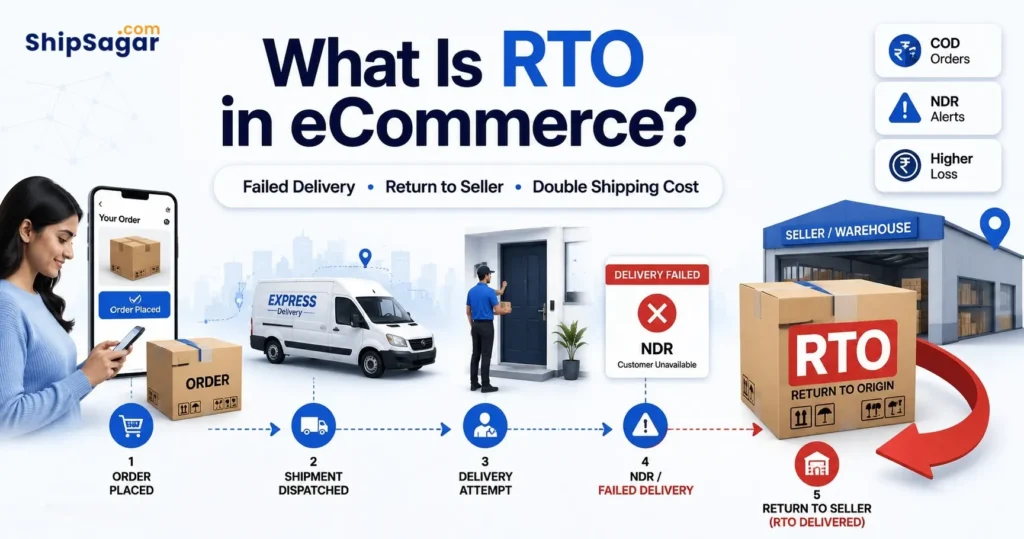
RTO stands for Return to Origin – a logistics term used in Indian eCommerce to describe a shipment that could not be delivered to the buyer and has been sent back to the seller’s pickup address (the origin). In plain terms: you shipped the order, the courier could not deliver it, and the parcel came back to you. You receive no sale revenue. You pay both forward shipping (seller to buyer) and reverse shipping (buyer to seller) – and you get nothing in return except the product back, sometimes in damaged condition.
| RTO in One Line: RTO = Failed delivery + parcel returned to seller + double shipping cost + zero revenue. |
RTO is also sometimes called Return-to-Origin shipment, failed delivery return, or undelivered parcel return. All refer to the same event: an order that did not reach the buyer and came back to the seller. In the tracking system of Indian couriers like Delhivery, Blue Dart, and DTDC, you will see this as “RTO Initiated” followed by “RTO Delivered” – the two status updates that confirm the return journey has begun and completed.
RTO vs Return – What Is the Difference?
This is one of the most common points of confusion for new Indian eCommerce sellers. RTO and Returns are very different events:
| Factor | RTO (Return to Origin) | Return |
| When it happens | BEFORE delivery – parcel never reached buyer | AFTER delivery – buyer received and then returned |
| Who initiates | Courier initiates – after failed delivery attempt(s) | Buyer initiates – after receiving the product |
| Revenue | Zero – no sale made | Sale was made – refund issued after return |
| Shipping cost | Double – forward + reverse shipping | Reverse shipping only (in most policies) |
| Cause | Wrong address, unavailable buyer, COD refusal, fake order | Product defect, wrong item, size issue, changed mind |
| How to reduce | Address verification, COD confirmation, NDR management | Quality control, accurate product description, size guides |
| Key Insight: RTO is more expensive than a return – because in a return, at least the sale happened and some revenue was collected. In an RTO, you paid to ship the product, paid to bring it back, and earned nothing. RTO is also harder to control because it happens before any customer interaction is complete. |
The RTO Journey – Step by Step
Understanding exactly how an RTO happens helps you identify where to intervene. Here is the complete journey of a typical RTO shipment in India:
- Order placed: Customer places a COD order on your website or marketplace. No payment made – just intent.
- Order packed and dispatched: Your team packs the order, generates AWB, and hands it to the courier. Forward shipping fee paid.
- In transit: Parcel moves through courier hubs – Delhi → Mumbai sorting center → Mumbai local hub.
- First delivery attempt: Courier executive arrives at the delivery address. One of several things happens: buyer is unavailable, address is incorrect, buyer refuses (COD), buyer does not have cash, or the contact number is unreachable.
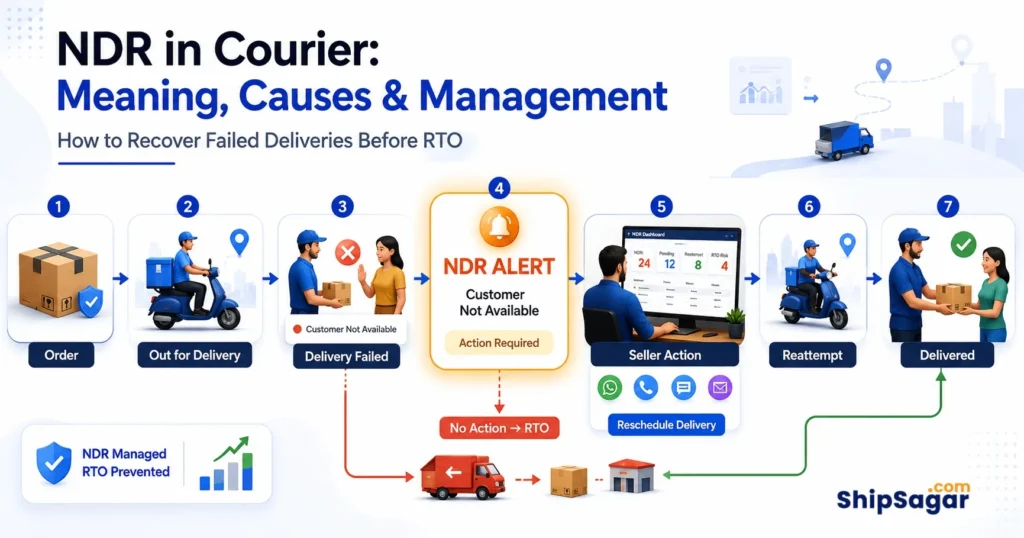
- NDR (Non-Delivery Report) generated: The courier logs a failed delivery attempt as an NDR with a reason code.
- Second and third delivery attempts: Most couriers attempt delivery 2–3 times before initiating RTO. Each failed attempt is another NDR.
- RTO Initiated: After all delivery attempts are exhausted without success, the courier marks the shipment as ‘RTO Initiated.’ The parcel begins its return journey.
- RTO Delivered: The parcel arrives back at your warehouse. Reverse shipping fee paid. Product inspected – sometimes damaged, sometimes missing items.
| The Critical Window – Where You Can Intervene: The most important moment in the RTO journey is STEP 5 – the NDR. When you receive an NDR alert, you still have time to contact the buyer, update the address, reschedule delivery, or convert COD to prepaid. Once ‘RTO Initiated’ fires (Step 7), it is almost always too late to save the order. ShipSagar’s real-time NDR alerts fire at Step 5 – giving your team the maximum window to prevent the RTO before it becomes confirmed. |
Why RTO Happens in India – 8 Root Causes
Most RTOs in Indian eCommerce trace back to a handful of predictable causes. Here are the eight most common – and why each is particularly acute in Indian logistics:
Cause 1 – Wrong or Incomplete Address
India’s address infrastructure is complex and inconsistent – especially in Tier 2, Tier 3, and rural areas where house numbers may not exist, landmarks are the primary navigation tool, and pincodes are shared across large areas. Missing apartment numbers, incorrect pincodes, misspelled street names, or missing landmark references make delivery impossible for courier executives who cannot locate the address. How common: Incorrect or incomplete address is consistently the #1 cause of RTOs in India, responsible for 30–40% of all NDRs across most D2C categories.
Cause 2 – Buyer Unavailable at Delivery
The courier executive arrives at the correct address, but the buyer is not home – at work, out shopping, or simply unavailable. Most couriers make 2–3 delivery attempts before initiating RTO. If the buyer is unavailable across all attempts, the parcel returns. How to reduce: Proactive Out-for-Delivery (OFD) WhatsApp notifications give buyers advance notice so they can be available or reschedule.
Cause 3 – COD Refusal at Doorstep
For COD orders, the buyer has made no financial commitment until the parcel arrives. They can refuse delivery at the doorstep at zero cost to themselves – while you bear the full forward and reverse shipping cost. Reasons for COD refusal include impulse order regret, changed mind during transit, discovering the product elsewhere at a lower price, or simply not having cash available. Data: According to GoKwik data, COD orders have a 26% RTO rate compared to under 2% for prepaid orders – a 13x difference in failure rate.
Cause 4 – Unreachable Contact Number
If the buyer’s phone number is incorrect, disconnected, or simply not answered, the courier executive cannot coordinate delivery. In Tier 2 and Tier 3 cities, language barriers between courier executives and buyers add another layer of communication failure – a Hindi-speaking courier calling a Tamil-speaking buyer with no common language often results in a failed delivery.
Cause 5 – Delayed Delivery (Customer Cancels)
When a parcel takes longer than expected – due to peak season delays, courier hub backlogs, or distance – buyers who ordered time-sensitive items (festival gifts, event-specific products) cancel or refuse delivery because the item is no longer useful to them. This is particularly common during Diwali, New Year, and wedding season.
Cause 6 – Fake COD Orders (Order Fraud)
A significant percentage of COD orders in India are placed with no genuine intent to accept delivery – by bots, competitors, or serial refusers. Fashion and lifestyle categories are particularly vulnerable, where competitors place fake orders to deplete inventory or damage seller metrics on marketplaces. Signal: Multiple orders to the same address or phone number across short timeframes, orders to non-residential addresses, or patterns of refusal from specific pincodes.
Cause 7 – Pincode Not Serviceable
Some rural, hilly, or remote pincodes are not covered by private couriers – or are covered only by India Post, which sellers may not have integrated. When an order ships to a pincode the selected courier cannot reach, the shipment returns without a single delivery attempt. Solution: Pincode serviceability check at checkout – block non-serviceable pincodes or automatically route to India Post for covered rural pincodes.
Cause 8 – Product or Packaging Issue at Doorstep
Damaged packaging, visible tampering, or product-description mismatch (buyer ordered something different from what arrived) cause buyers to refuse delivery at the doorstep. While less common than address or COD issues, this cause is particularly problematic because it both creates an RTO AND damages the brand relationship with that customer permanently.
| # | Cause | Estimated % of RTOs | Primary Solution |
| 1 | Wrong / incomplete address | 30–40% | Address validation at checkout + confirmation |
| 2 | Buyer unavailable | 20–25% | OFD WhatsApp notification – advance notice |
| 3 | COD refusal at doorstep | 15–20% | COD confirmation call/WhatsApp + prepaid push |
| 4 | Unreachable contact number | 10–15% | Phone validation at checkout |
| 5 | Delayed delivery + cancellation | 5–10% | Proactive delay notifications + EDD accuracy |
| 6 | Fake COD orders (fraud) | 5–10% | Risk scoring + OTP verification |
| 7 | Pincode not serviceable | 3–5% | Pincode check at checkout |
| 8 | Product / packaging issue | 2–5% | Packaging quality control + packing video |
The Real Cost of RTO – What It Actually Takes From Your Business
Most sellers understand RTO as a logistics cost – double shipping fees. The real cost is significantly higher when you account for all the direct and indirect losses:
1 Direct Costs
- Forward shipping cost: You pay the full outbound shipping fee – ₹40–120 depending on weight, courier, and distance.
- Reverse shipping cost: RTO return shipping is typically 70–100% of the forward shipping cost – some couriers charge flat RTO fees. Total shipping cost per failed order: ₹80–240.
- COD handling charges: Most couriers charge ₹20–40 per COD shipment. You pay this even on RTOs.
- RTO surcharge: Some couriers charge an additional ₹20–60 ‘RTO fee’ on top of reverse shipping.
- Repackaging cost: Products returned via RTO often need inspection, repackaging, and quality checking before they can be resold – typically ₹15–30 per unit.
- Product damage: An estimated 15–20% of RTO shipments arrive back in damaged or unsellable condition.
2 Hidden / Indirect Costs
- Cash flow blockage: For COD orders with 7–14 day courier remittance cycles, RTO shipments block working capital for 3–5 weeks – the time from dispatch to RTO delivered + reconciliation.
- Inventory hold: While a product is in transit as an RTO, it cannot be sold to another customer. For limited-stock SKUs, this is a direct lost sale.
- Operations overhead: Your team spends time on NDR follow-up, RTO tracking, reconciliation, and re-listing returned items. At scale, this is significant staff cost.
- Customer acquisition cost (CAC) lost: If the order originated from a paid ad – Meta, Google – you already spent ₹150–500 to acquire that customer. RTO means that CAC is completely wasted.
- Distorted revenue reporting: RTOs inflate your gross order count and gross revenue numbers without corresponding actual revenue – leading to inaccurate business decisions based on falsely positive data.
| RTO Cost Calculator – Real Example: Scenario: D2C fashion brand, 1,000 orders/month, 25% RTO rate = 250 RTOs/month • Forward shipping (250 × ₹80): ₹20,000 • Reverse shipping (250 × ₹70): ₹17,500 • COD handling (250 × ₹30): ₹7,500 • Repackaging (250 × ₹20): ₹5,000 • Product damage/loss (50 units × ₹400 avg): ₹20,000 • Lost CAC from paid ads (250 × ₹200): ₹50,000 Total monthly RTO cost: ₹1,20,000 – on just 250 failed orders. At 15% RTO (after intervention): 150 RTOs × same costs = ₹72,000/month saved. |
RTO Rates by Category – Which Products Are Most at Risk?
RTO rates vary significantly by product category in Indian eCommerce. Understanding which categories carry highest risk helps you allocate COD verification effort appropriately:
| Category | Avg. RTO Rate | Primary Cause | Risk Level |
| Fashion & Apparel | 30–40% | Impulse COD orders, sizing issues, doorstep refusals | Highest |
| Footwear | 25–35% | Size mismatch, COD refusal, address issues | Very High |
| General Merchandise | 25–35% | Low ticket value, casual COD, fake orders | Very High |
| Home & Furniture | 15–25% | Buyer unavailable, address complexity for large items | High |
| Beauty & Personal Care | 12–20% | Impulse COD, product expectation mismatch | Medium-High |
| Electronics & Accessories | 8–15% | Higher ticket = lower COD, better buyer intent | Medium |
| Health Supplements | 5–12% | Repeat buyers, higher prepaid rate | Low-Medium |
| Books & Stationery | 3–8% | Lightweight, low value, committed buyers | Low |
Source: Industry averages based on GoKwik data (180M+ shoppers), Shipway, and ClickPost published research. Actual rates vary by brand, courier mix, and geography.
RTO and COD – Why Cash on Delivery Is the Core Driver
To understand RTO in Indian eCommerce, you have to understand COD. According to GoKwik data across 180+ million Indian shoppers, COD accounts for 60–70% of all eCommerce orders in India – with even higher rates in Tier 2 and Tier 3 cities for fashion, lifestyle, and general merchandise. The core problem is structural: when a buyer places a COD order, they have made zero financial commitment. The friction of refusing delivery at the doorstep is near-zero – they simply say ‘no’ to the courier executive and walk away. The seller, meanwhile, has already spent money on product procurement, packaging, and forward shipping.
| Payment Type | Average RTO Rate | Why |
| Prepaid (UPI/Card/Netbanking) | < 2% | Buyer has committed money – strong intent to receive |
| COD (Cash on Delivery) | ~26% (up to 40% in fashion) | Zero financial commitment – easy to refuse at doorstep |
This 13x difference in RTO rate between prepaid and COD is why reducing COD share is the single highest-ROI intervention for D2C brands with high RTO rates. Even converting 20% of COD orders to prepaid – with a small ₹30–100 prepaid incentive – can reduce total RTO rate from 25% to 18–20%, saving thousands of rupees monthly.
10 Proven Strategies to Reduce RTO for Indian eCommerce Brands
RTO cannot be eliminated – but it can be controlled. Here are ten strategies that Indian D2C brands use to meaningfully reduce their RTO rate:
Strategy 1 – Validate Addresses at Checkout (Reduce Cause 1 by 50–70%)
The single most impactful RTO intervention. Add address validation at checkout – pincode-level validation that flags incomplete addresses, confirms pincode-city matches, and prompts buyers to add missing landmark or apartment information before the order is placed. Tools: Shopify address validation apps, Delhivery’s pincode API, or custom checkout validation. ShipSagar’s carrier analytics also flags pincodes with consistently high RTO rates.
Strategy 2 – COD Confirmation Call or WhatsApp Before Dispatch
Before dispatching a COD order, send a WhatsApp confirmation message or IVR call to confirm the buyer’s intent. Ask them to reply ‘CONFIRM’ to confirm delivery. Buyers who do not respond after 2 reminders are higher-risk – consider calling them directly or delaying dispatch. This step catches fake orders and low-intent buyers before the courier charges begin. Typical COD confirmation reduces RTO by 15–25% on confirmed orders.
Strategy 3 – Push Prepaid with Incentives (Most Impactful Long-Term)
Since prepaid orders have < 2% RTO vs COD’s 26%, even a 15–20% shift from COD to prepaid dramatically reduces your overall RTO rate. Offer small, genuine incentives at checkout:
- ₹30–100 prepaid discount (clear, visible at checkout)
- Free shipping for prepaid (when COD carries shipping charge)
- Faster delivery timeline for prepaid orders
- Post-OTP-confirmation WhatsApp message: ‘Switch to UPI and save ₹50 – one click payment link’
Strategy 4 – Act on NDR Alerts Immediately (Most Critical Operational Step)
When a delivery attempt fails and an NDR is generated, you have a narrow window to intervene before RTO is confirmed. The standard window is 24–48 hours from NDR generation. Your operations team should:
- Contact the buyer via WhatsApp/call within 2–4 hours of NDR alert
- Confirm if the address is correct
- Reschedule delivery for a specific time slot
- For COD orders: offer to switch to UPI at the doorstep
| ShipSagar’s real-time NDR alerts fire the moment a delivery attempt fails – giving your team maximum intervention time. Learn how to set up NDR alerts: Multi-Courier Tracking Dashboard |
Know more about: What is NDR in Courier? Meaning, Causes & How to Manage
Also read: Delivery Attempt Failed? NDR, Reattempt Guide
Strategy 5 – OTP / Risk Scoring for High-Risk Orders
Add an OTP verification step for COD orders above a certain value – ₹500, ₹800, or ₹1,000 depending on your category. Buyers who complete OTP verification have demonstrated higher intent. This step alone can eliminate 60–70% of fake COD orders. Additional risk signals to flag: Multiple orders from same phone/address in short period, orders from pincodes with historically high RTO in your carrier analytics, orders where phone number format is invalid.
Strategy 6 – Send Out-for-Delivery WhatsApp Notifications
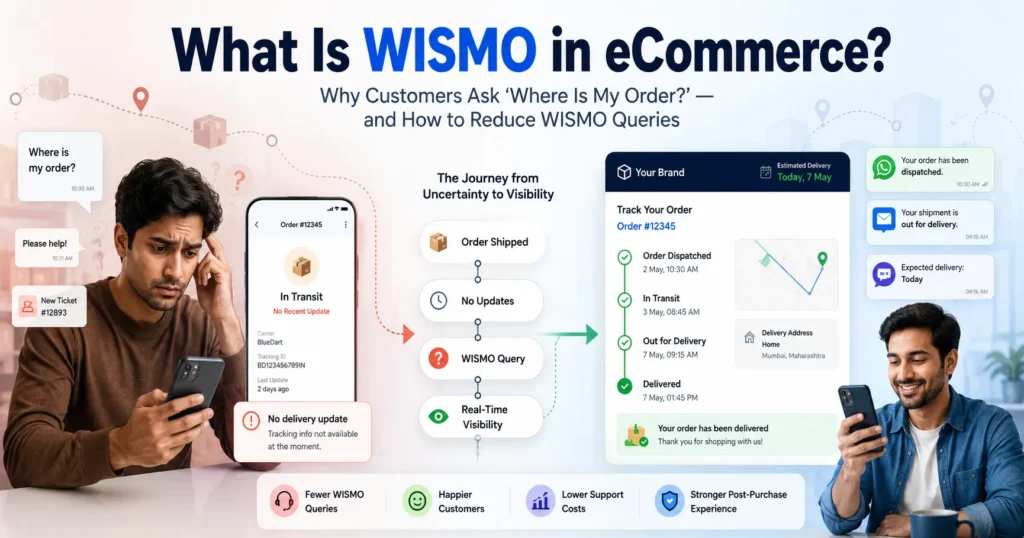
One of the most under-utilized RTO reduction tools is simply telling the customer their parcel is coming today via WhatsApp. An OFD (Out for Delivery) notification at 8–9 AM gives buyers enough notice to ensure they are home, have cash ready for COD, or arrange for someone else to receive the parcel. ShipSagar sends automated Email + SMS + WhatsApp* (add on-facility) notifications at every tracking milestone – including OFD – to all customers across 500+ couriers automatically.
Strategy 7 – Analyze Carrier Performance by Pincode
Not all couriers perform equally across all pincodes. Courier A may have 15% RTO in Rajasthan but 40% in rural Bihar. Without data, you are allocating courier partners based on rate negotiations, not delivery performance. Use ShipSagar’s carrier analytics – Delivered%, RTO%, and average transit time per courier per geography – to identify which courier performs best for each zone and allocate accordingly. Switching from an underperforming carrier for a specific state can reduce RTO by 8–12 percentage points in that zone. → Learn more: Courier Tracking India: Complete Guide
Strategy 8 – Block High-Risk Pincodes from COD
Some pincodes in India have structurally high RTO rates – due to delivery infrastructure gaps, courier coverage limitations, or concentrated fake order activity. Block COD for pincodes where your historical RTO rate exceeds 35–40%, and offer only prepaid or alternate payment options for those locations.
Strategy 9 – Keep Packing Videos for High-Value Orders
For orders above ₹1,000–2,000, maintain packing videos – a short recording of the packing process that shows the correct item being packed in good condition. This protects against both false RTO damage claims and marketplace dispute resolution.
Strategy 10 – Track Repeat RTO Customers and Block Them
Some customers place COD orders repeatedly across multiple sellers and refuse every time. Track which phone numbers or addresses have generated RTOs for your brand and either block COD for them on repeat orders or require OTP verification. Most eCommerce platforms support customer tagging for this purpose.
How to Track and Monitor RTO – Key Metrics Every Seller Should Watch
| Metric | What It Measures | Healthy Benchmark |
| RTO Rate | % of total orders that returned as RTO. Primary KPI. | < 10% overall. < 20% COD-only. |
| COD RTO Rate | % of COD orders specifically that become RTO. | < 20% (industry avg is 26%) |
| NDR-to-RTO Conversion Rate | % of NDRs that eventually become RTOs. Measures intervention effectiveness. | < 40% (lower = better interventions) |
| First Attempt Delivery Rate | % of orders delivered successfully on first attempt. | > 80% is strong performance |
| RTO Rate by Courier | Which couriers have highest RTO in which states/zones. | Use to reallocate away from poor performers |
| Prepaid vs COD Split | % of orders that are prepaid. Higher prepaid = lower RTO. | Target > 40% prepaid for D2C brands |
Review frequency: Weekly for the first 90 days of any RTO intervention. Monthly once rates stabilize. Daily during festive season peak.
How ShipSagar Helps You Detect and Prevent RTOs
ShipSagar is India’s unified shipment tracking platform – tracking 500+ Indian and global couriers in one dashboard. Here is specifically how ShipSagar addresses RTO:
| RTO Challenge | ShipSagar Solution |
| Late NDR detection | Real-time NDR alerts – your team is notified the moment a delivery fails. Maximum intervention window before RTO is confirmed. |
| No visibility into which couriers cause most RTOs | Carrier analytics: per-courier RTO% across all shipping partners. Identify and replace underperforming couriers by zone. |
| Customers don’t know where order is – cancel or refuse | Automated WhatsApp* (add-on extra cost) + SMS + Email at every milestone – including OFD notification that reduces ‘buyer unavailable’ RTOs. |
| Downloadable NDR reports for ops team | Downloadable NDR reports filterable by courier, date, status, and pincode – enables weekly RTO pattern analysis. |
| No single dashboard for all couriers | 500+ couriers unified – Delhivery, Blue Dart, DTDC, India Post, XpressBees and more. One dashboard, one login. |
| Start Free on ShipSagar: Track all your shipments across 500+ couriers, get real-time NDR alerts, download NDR reports, and monitor per-courier RTO% from one dashboard. Free Plan: 50 shipments, lifetime free, no credit card. Growth Plan: Start at ₹2/shipment – all features including NDR reports, carrier analytics, WhatsApp* (add-on extra cost) + SMS + Email notifications. |
→ Multi-courier tracking + NDR management: shipsagar.com/multi-courier-tracking/ → Understand all tracking statuses including RTO: Parcel Delivery Tracking: Complete Guide
Related Guides on ShipSagar
For a deeper understanding of Indian courier tracking and post-purchase operations:
- What is NDR in Courier? Meaning, Causes & How to Manage It
- Courier Tracking India: Complete Guide – Delhivery, Blue Dart, India Post & 500+ More
- Parcel Delivery Tracking: Complete Guide for Indian eCommerce Brands
- How to Reduce WISMO Calls with Smart Parcel Tracking Software
ShipSagar Solutions: